
If you are a US business or agency weighing where to send your search engine optimization work, two names dominate the shortlist: India and the Philippines. Both offer skilled talent at a fraction of US rates, both speak English, and both have built entire industries around serving Western clients. But “outsourcing” is a broad word, and SEO is a specific discipline. The right answer depends less on which country is “better” overall and more on which country is better at the actual work SEO demands: technical audits, content at scale, link building, and long-term strategy. This guide compares the two honestly, with attributed data where it exists, so you can make a confident call.
TL;DR: The Short Answer
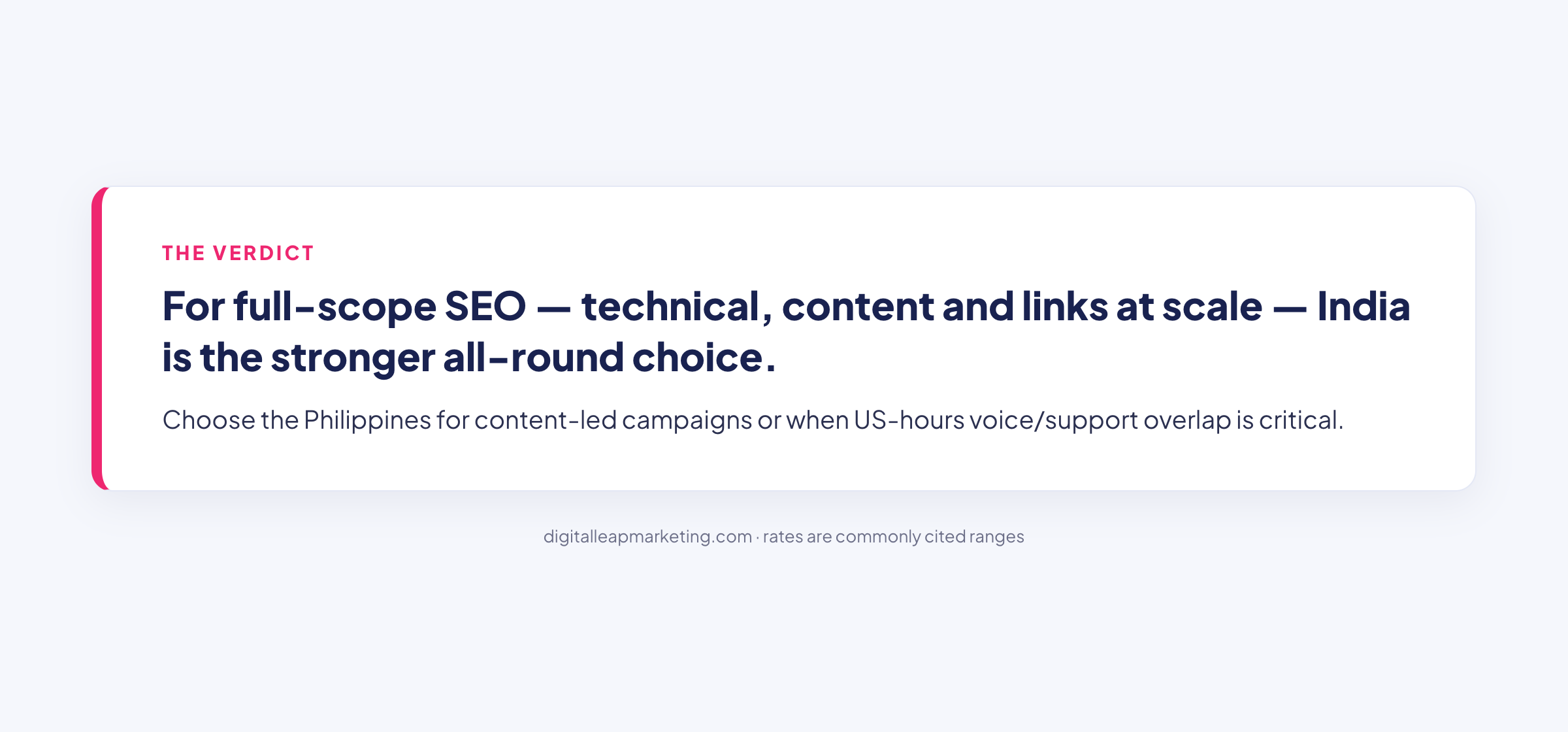
For full-scope SEO, India is the stronger all-round choice. It offers the deepest technical and content talent pool, competitive pricing, and a mature agency ecosystem built specifically around search. The Philippines is an excellent partner for voice-heavy, customer-facing, and virtual-assistant style tasks, and its spoken English is widely rated among the best in Asia. If your priority is rankings, technical execution, and content production, India tends to win on cost-per-quality. If your priority is customer support, social engagement, or live communication attached to your marketing, the Philippines deserves a serious look.
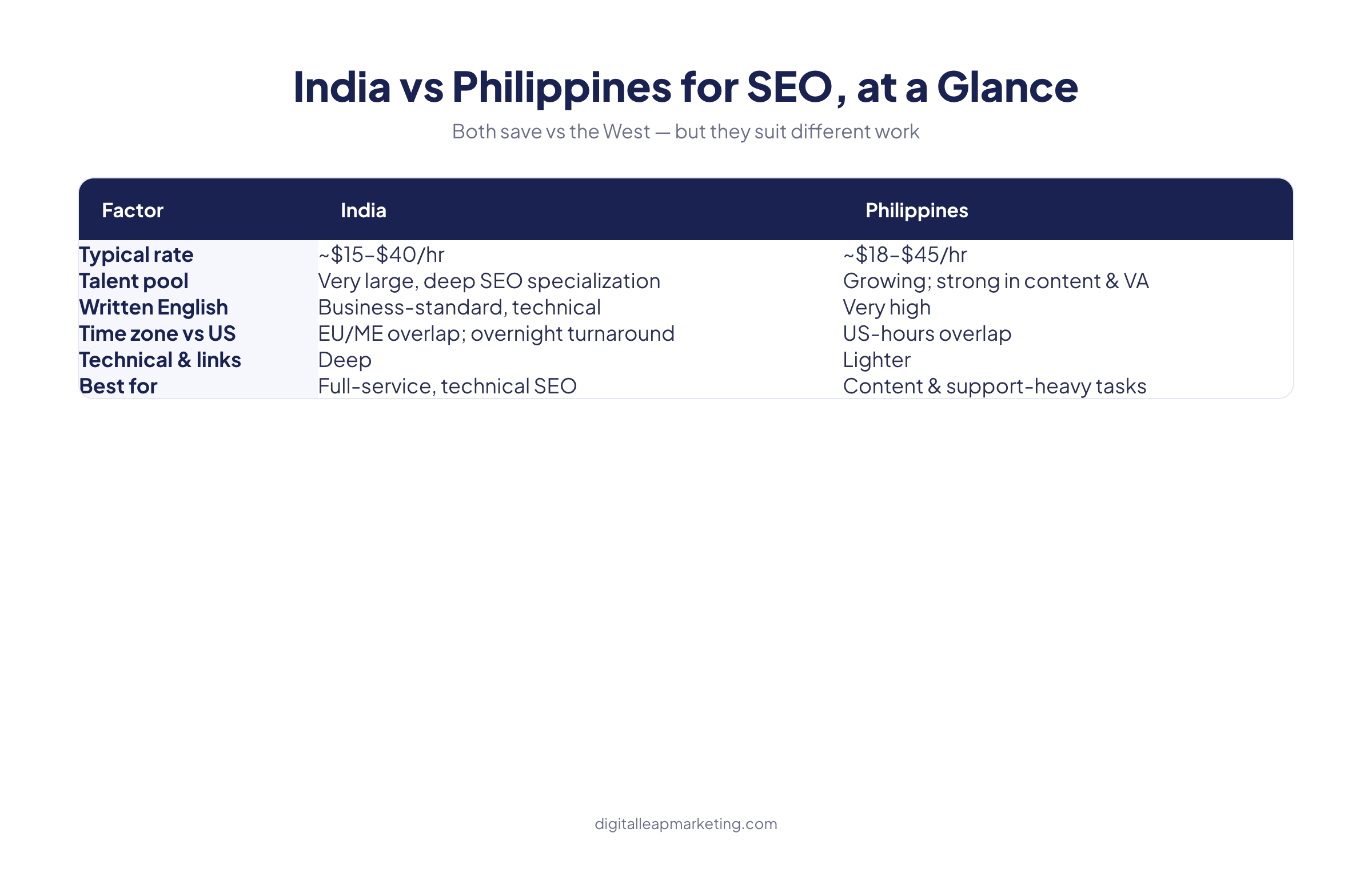
India vs Philippines for SEO Outsourcing: At a Glance
| Factor | India | Philippines |
|---|---|---|
| Typical hourly rate (SEO) | Commonly cited ~$15–$40/hr | Commonly cited ~$18–$45/hr |
| Talent pool depth | Very large; deep technical + content bench | Large; strongest in support and VA roles |
| Written English | Strong for technical/business writing | Strong; conversational tone |
| Spoken English | Good; regional accent variation | Excellent; neutral, US-familiar accent |
| Time zone vs US | IST (UTC+5:30) — full overnight cycle | PHT (UTC+8) — similar overnight cycle |
| Technical & link-building depth | Deep; established SEO/dev ecosystem | Moderate; growing but support-led |
| Best-fit use case | Full-scope SEO, content, technical, strategy | Voice, customer support, social, VA tasks |
The rest of this article breaks down each of these dimensions with real context, then answers the question that actually matters: which country ranks you higher for the money? If you already know India is your direction, our SEO outsourcing company in India guide covers how to get started; if you are still deciding, read on.
Cost Comparison: What You’ll Actually Pay
Cost is usually the trigger for outsourcing in the first place, so let’s start there and be precise about what the numbers mean.
Hourly and Monthly Rate Ranges
Both countries sit far below US and UK pricing, and the two are closer to each other than most people assume. Typical, commonly cited hourly rates land around $15–$40 in India and around $18–$45 in the Philippines, with senior strategists and specialized technical roles pushing higher in both. On a retainer basis, small-to-mid engagements commonly fall in the $500–$2,500 per month range depending on scope, deliverable volume, and seniority. Treat these as market benchmarks, not quotes — the spread inside each country is wider than the gap between them.
The Cost-of-Living Context
Lower rates are anchored in lower operating costs. According to LivingCost.org, the average cost of living in India is roughly $441 versus about $614 in the Philippines, making India approximately 28% less expensive. That structural difference is part of why India can field experienced strategists at rates that would only buy entry-level help elsewhere. It is not about corners being cut; it is about a lower cost base translating into more capability per dollar.
Cost-Per-Quality, Not Cost-Per-Hour
The honest way to compare price is not the hourly rate but what that hour produces. A cheaper hour that yields a thin, templated blog post is more expensive than a slightly pricier hour that delivers a technically sound page targeting the right keyword research. India’s advantage is that the same budget often buys a more experienced strategist, simply because the talent pool for senior SEO roles is larger and more competitive. For a fuller breakdown of scope-based pricing, our how to outsource SEO to India guide walks through what each budget tier realistically covers.
English Proficiency and Communication
Language is where the two countries genuinely differ, and where a lot of outdated assumptions live. The nuance matters because SEO is a written discipline first.
Spoken vs Written English
Per the EF English Proficiency Index, the Philippines consistently ranks in the “high proficiency” band and is regularly among the top-rated English-speaking countries in Asia, helped by English being an official language and its long history in voice-based services. India is typically rated in the “moderate proficiency” band on the same index, with more regional accent variation in spoken English. If your work is phone-based, live chat, or customer-facing, the Philippines’ neutral, US-familiar accent is a real, measurable advantage.
Why Written English Matters More for SEO
Here is the twist: SEO deliverables are overwhelmingly written — long-form content, meta data, audit reports, outreach emails, and strategy documents. India’s large pool of technical and business writers is deep in exactly this kind of structured, precise English, and the country’s long standing in IT and content services shows in the quality of written documentation. Both countries produce excellent writers, but the sheer scale of India’s content and technical-writing workforce means it is easier to staff a team that writes at a native-enough level for US search intent. For SEO specifically, strong written English tends to matter more than a polished phone accent.
Talent Pool and Technical Depth
This is the dimension that most clearly favors India for search work, and it is worth being specific about why.
India’s outsourcing industry grew out of software and IT services, which means the country has a very large base of developers, technical specialists, and content professionals. That matters for SEO because modern search work is increasingly technical: site speed, crawlability, structured data, and internal linking sit alongside content. When your provider needs to implement schema markup, diagnose a rendering issue, or fix a on-page SEO problem, India’s engineering-adjacent talent depth is a genuine edge.
The Philippines built its outsourcing reputation on business process outsourcing (BPO) — call centers, customer support, and virtual assistance — and it excels there. For SEO, that translates into strong support-style roles: content coordination, social media management, and VA-driven tasks like data entry and reporting. What is generally harder to staff at scale in the Philippines is the deep technical SEO and backlink outreach bench that India offers, simply because the local industry grew in a different direction.
One honest caveat: India’s talent range is wide. Because the pool is so large, quality varies enormously between the bottom and top tiers. The advantage only materializes if you engage the senior tier — which is exactly why vendor selection matters more than country selection.
India’s SEO Market Depth and Talent Scale
It helps to put numbers behind the “large talent pool” claim, because the scale is genuinely hard to match. India’s IT and business process management (IT-BPM) sector is one of the largest in the world. According to industry association NASSCOM, the sector generates well over $250 billion in annual revenue and employs more than 5 million professionals — a workforce built over three decades of serving global clients. That base is the reservoir SEO talent is drawn from.
The pipeline behind it is just as important. India produces a very large volume of engineering and technical graduates each year — figures commonly cited from bodies such as AICTE put the number in the region of 1.5 million annually — which continually refreshes the supply of people comfortable with the technical side of search. On the demand side, English is an associate official language and a primary medium of higher education and business, so written business English is embedded in the professional workforce rather than being a specialist skill.
For SEO specifically, three consequences follow from this scale:
- Specialization is possible. A large market supports specialists — technical SEO leads, content strategists, digital PR and link builders, and analytics specialists — rather than generalists stretched across everything.
- Established agency infrastructure. India has a mature ecosystem of SEO agencies and in-house teams with documented processes, QA layers, and reporting standards refined on global accounts.
- Continuity and redundancy. Deep benches mean an engagement is less likely to stall because one person leaves; there is capacity to cover and scale.
None of this makes India automatically the right choice — a large market also contains a large low-quality tier. But it does mean that when you find the senior tier, the depth, specialization, and process maturity available are difficult to replicate elsewhere at the same price. Treat these figures as widely reported industry benchmarks rather than precise, point-in-time statistics; the orders of magnitude are what matter for this decision.
Time Zone and Turnaround
For US clients, both countries are on the other side of the clock, and that is mostly a feature, not a bug. India runs on IST (UTC+5:30) and the Philippines on PHT (UTC+8), so both sit roughly a full day ahead of US business hours. The practical result is a 24-hour production cycle: you brief work at the end of your day and wake up to completed deliverables.
The Philippines’ three-and-a-half-hour lead over India puts it marginally closer to Australian hours, but for US clients the difference between the two is minor. Both countries routinely schedule a few overlapping hours — early US morning, their evening — for live calls. Reputable providers in either location build this overlap into their process, so time zone is rarely a deciding factor between the two for US teams.
Culture, Work Style, and Reliability
Culture shapes how a partnership feels day to day, and the two countries have distinct strengths. The Philippines has deep Western — particularly American — cultural affinity, and its service culture emphasizes warmth, rapport, and friendly, accommodating communication. That makes Filipino teams a pleasure to work with on anything customer-facing.
India’s outsourcing culture is more process-and-delivery oriented, shaped by decades of running large IT and agency engagements for global clients. In practice, that often shows up as more direct reporting — teams that tell you when a strategy is underperforming and explain why, rather than smoothing it over. For SEO, where you need honest data about what is and isn’t ranking, that directness is an asset: it lets you fix issues in hours instead of weeks. Neither style is universally “better”; the question is whether you value diplomatic warmth or candid, delivery-focused reporting more for this particular work.
The “Cheap SEO = Bad SEO” Myth
Spend any time in agency forums and you will find the warning: outsourcing SEO overseas, especially to India, means cheap, spammy work that gets you penalized. It is a fair concern rooted in real bad experiences — but it confuses price with quality, and country with vendor.
The uncomfortable truth is that low-quality SEO exists everywhere, including in the US at premium prices. What burns people is not India or the Philippines; it is choosing a provider on rock-bottom price alone and getting rock-bottom process in return: mass-produced content, spun articles, and link schemes that violate Google’s guidelines. Those same red flags appear regardless of geography.
The senior tier in India — and in the Philippines — does careful, white-hat, results-driven work. The cheap tier does not. Cheap is not a country; it is a choice. For a deeper list of what to watch for, see our guide on SEO outsourcing mistakes to avoid, and if you are weighing offshore against building internally, in-house SEO vs outsourcing lays out the trade-offs.
How to Vet an SEO Provider (India or Philippines)
Because the gap between a great and a poor provider is larger than the gap between the two countries, vetting is the single most important thing you can do. Use this as a checklist when you shortlist any offshore partner. Watch for these green flags:
- Verifiable case studies with ranking or traffic data you can check, not just a wall of client logos.
- A sample deliverable up front — a mini audit or a content piece — before you commit to a retainer.
- Editorial, relevance-based link building that earns placements on real sites, not bulk directories or private blog networks.
- Transparent reporting and a named point of contact, ideally with access to your own analytics and search console data.
- A clear, documented process for audits, content, and QA that they can walk you through.
And treat these as red flags worth walking away from:
- Guaranteed #1 rankings or promises of results in unrealistic timeframes.
- Prices so low they could only be met by automation, spun content, or link schemes.
- Vague deliverables — “we’ll do SEO” with no scope, cadence, or reporting defined.
- No named contact or an anonymous ticket queue instead of an accountable person.
- Reluctance to share methods, past work, or references.
Run this checklist against providers in either country and you will filter out the tier that gives offshore SEO a bad name — which is exactly the tier the “cheap SEO” warnings are really about.
When the Philippines Is the Better Pick
An honest comparison has to say where the Philippines wins outright, because for some engagements it clearly does. Consider the Philippines first when:
- Your work is voice-heavy. Live customer support, sales calls, or appointment setting attached to your marketing benefit from the Philippines’ neutral accent and top-tier spoken English.
- You need social and community management. Filipino teams excel at friendly, real-time engagement across social platforms.
- You want virtual-assistant support. Reporting coordination, inbox and calendar management, and data-entry-style SEO tasks are a Philippine strength.
- Customer experience is the deliverable. Where rapport and warmth drive the outcome, Filipino service culture is hard to beat.
Plenty of smart companies run a hybrid: India for core SEO strategy, technical work, and content, and the Philippines for customer-facing and support layers. Choosing one country does not have to mean rejecting the other.
A Hybrid Model in Practice
Consider a mid-sized US e-commerce brand — the pattern here is a composite of common setups rather than a single named client. The company needed to climb rankings for competitive product categories while also handling a rising volume of pre-sale customer questions on chat and social. Sending everything to one vendor would have meant compromising on either the technical depth or the live-support quality.
The hybrid solution split the work by strength. An India-based SEO team owned the ranking engine: a technical audit, fixing crawl and structured-data issues, rebuilding category and product pages around real search intent, and running an editorial link-building campaign. A Philippines-based team owned the human-facing layer: live chat, social replies, and review responses, with a neutral accent and quick, warm turnaround. The two teams shared a weekly reporting rhythm so support insights fed back into content priorities.
The takeaway is not that hybrid is always right — for many businesses a single India-based partner covers the full SEO scope perfectly well. It is that “India vs Philippines” does not have to be either-or. Match each stream of work to the country that does it best, and you get the technical firepower of one with the customer warmth of the other.
The Verdict: Why India Wins for Full-Scope SEO
When the deliverable is rankings — technical health, content that satisfies search intent, and links that actually move the needle — India offers the strongest combination of talent depth, written English, competitive pricing, and agency maturity. The Philippines is a genuinely excellent outsourcing destination, and for voice and support work it may be the better call. But for the specific job of getting a US site to rank and stay ranked, India’s engineering-adjacent talent pool and cost-per-quality advantage make it the smarter all-round choice for most businesses.
The bigger lesson is that country is a starting filter, not the decision. The gap between a great provider and a poor one, within either country, is far larger than the gap between the two countries. Vet the vendor, verify the results, and align the engagement to the work.
Frequently Asked Questions
Which is better, India or the Philippines?
It depends on the work. For full-scope SEO — technical, content, and link building — India generally wins on talent depth and cost-per-quality. For voice, customer support, and virtual-assistant tasks, the Philippines is often the better fit thanks to its top-rated spoken English and service culture. Many companies use both.
Is outsourcing SEO to India worth it?
Yes, when you engage the right provider. India offers experienced strategists, deep technical talent, and strong written English at rates well below US pricing. The value comes from choosing the senior tier and verifying results — not from picking the cheapest option. Our benefits of outsourcing SEO guide covers the upside in detail.
How much does it cost to outsource SEO to India or the Philippines?
Typical, commonly cited hourly rates run about $15–$40 in India and about $18–$45 in the Philippines, with senior and specialized roles higher. Retainers for small-to-mid engagements commonly fall in the $500–$2,500 per month range depending on scope. Treat these as market benchmarks rather than fixed quotes.
What are typical India vs Philippines SEO rates?
The two are closer than most expect. India tends to be marginally cheaper on average, supported by a lower cost of living — roughly 28% less than the Philippines according to LivingCost.org. The larger difference is within each country, between entry-level and senior talent, so focus on the quality tier you are buying, not just the flag.
Why do US companies outsource to the Philippines?
US companies favor the Philippines for its excellent, neutral-accent spoken English, strong American cultural affinity, and world-class customer-support and BPO capabilities. For voice-based and customer-facing work, those strengths make it a natural choice — which is why it is often paired with India rather than treated as a straight either-or.
Ready to see what full-scope SEO from India can do for your rankings? At Digital Leap, we help US businesses and agencies outsource SEO with senior-tier talent, transparent reporting, and white-hat execution. Explore our SEO outsourcing company in India services or reach out for a free, no-pressure consultation — and if you run an agency, ask about our white label SEO services for agencies.
Related: Not sure who to hire? See our ranked comparison of the best SEO outsourcing companies in India for 2026.