
Every growing business hits the same fork in the road: hire someone to run search engine optimization internally, or hand it to an outside team. It sounds like a simple staffing question, but it quietly shapes your marketing budget, your speed to results, and how much control you keep over one of your most valuable traffic channels. The honest answer is not “always outsource” or “always build in-house” — it depends on your budget, your growth stage, and how central organic search is to your business.
Should you do SEO in-house or outsource it? Outsource SEO when you need broad expertise fast and want to control costs — an agency or offshore partner typically launches quicker and runs cheaper than a full internal team. Build in-house when SEO is core to your business, you need daily control, and you can fund salaries plus tools. Most companies land on a hybrid of both.
Below is the head-to-head comparison most guides skip, followed by real US cost figures, the hybrid model, an honest look at the “outsourcing to India” question, and a simple framework to decide. No hype — just the trade-offs.
In-House SEO vs Outsourcing at a Glance
Before we dig into the detail, here is the side-by-side view. Use it to spot which model fits your situation, then read the sections that matter most to you.
| Factor | In-House SEO | Outsourced SEO (Agency / Offshore) |
|---|---|---|
| Cost | High fixed cost — salaries, benefits, and tools every month | Variable — retainer or project fee, no benefits or tool overhead |
| Time to launch | Slow — hiring and onboarding can take 1–3 months | Fast — an established team can start within days to two weeks |
| Expertise breadth | Narrow early — one or two generalists | Broad — technical, content, and link-building specialists on tap |
| Control | High — daily, direct oversight | Moderate — depends on communication cadence and reporting |
| Scalability | Slow — scaling means more hires | Fast — scale effort up or down by the month |
| Tools included | You buy them ($200–$500+/mo typically) | Usually included in the fee |
| Risk | Turnover and knowledge loss if a key person leaves | Vendor dependence; quality varies by partner |
| Best for | Brands where SEO is core and volume is constant | SMBs, startups, and agencies needing flexible expertise |
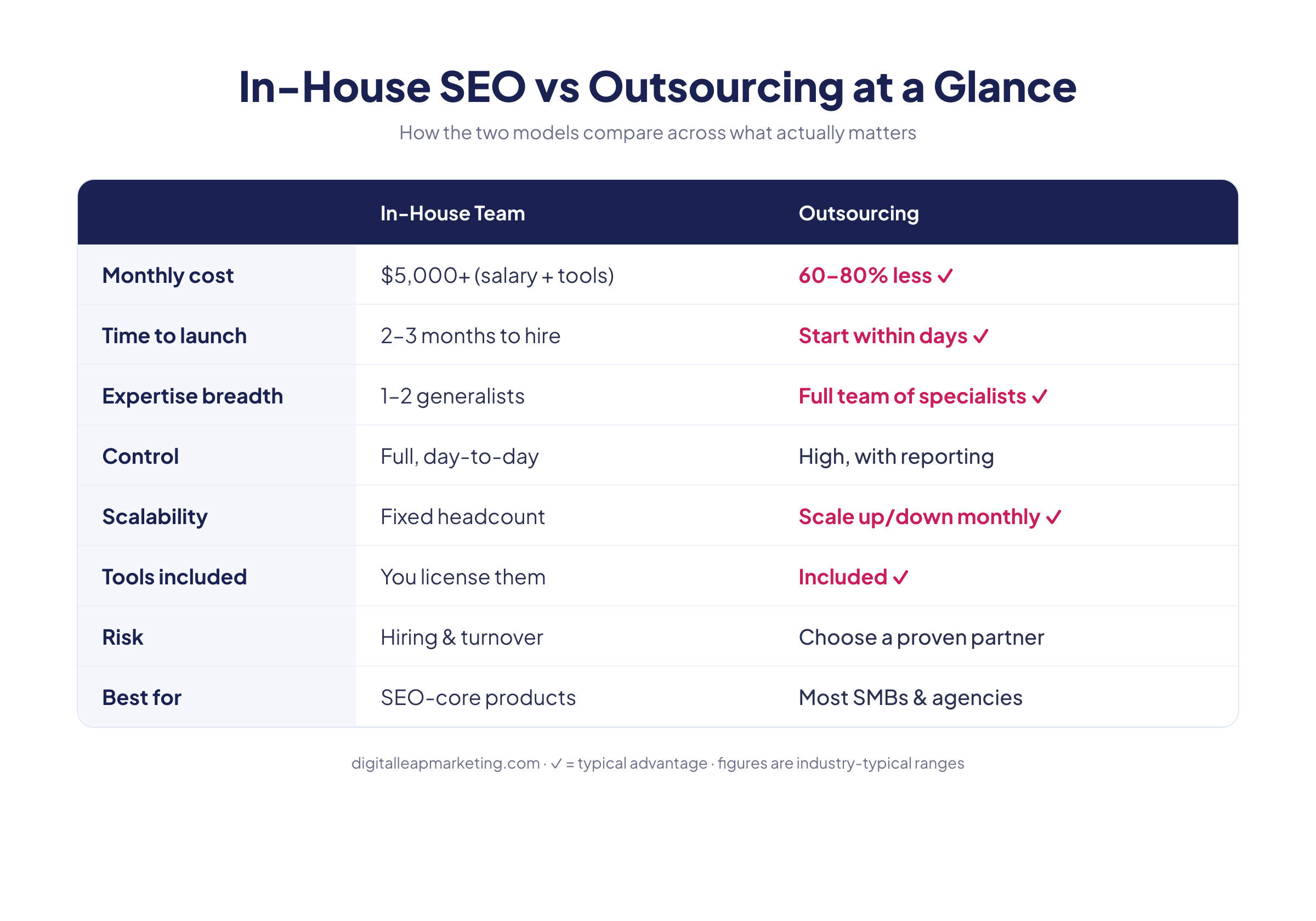
Notice that no single column “wins.” In-house buys you control and institutional knowledge; outsourcing buys you speed, breadth, and flexibility. The rest of this guide helps you weigh those trade-offs against your actual numbers.
What Is In-House SEO? (Pros and Cons)
In-house SEO means hiring employees who work only on your organic search — typically an SEO specialist or manager, sometimes supported by a content writer and a developer. They sit inside your company, learn your brand deeply, and are available for daily collaboration with product, content, and sales teams.
What an In-House SEO Team Actually Costs in the US
This is where many “just hire someone” conversations fall apart. US salaries for search talent are substantial, and salary is only part of the bill. Based on commonly cited US market ranges:
- SEO Specialist: typically ≈ $60,000–$80,000/year
- SEO Manager / Lead: typically ≈ $90,000–$120,000/year
- Benefits, payroll taxes, and overhead: commonly add ~25–35% on top of base salary
- Tool stack (rank tracking, audits, backlink data, content tools): typically ≈ $200–$500+/month
Add it up and a single competent in-house hire commonly lands north of $85,000–$110,000 all-in per year before you have written a single piece of content or built one link. And one person rarely covers everything — modern SEO spans technical fixes, on-page optimization, content, and off-page link building. Expecting one generalist to master all of it is optimistic.
When In-House SEO Makes Sense
- Organic search is a core, permanent channel (large e-commerce, publishers, SaaS)
- You have steady, high-volume work that justifies a full-time salary
- You need tight daily coordination with product and engineering
- You can fund salaries, benefits, and tools without straining the budget
The trade-off: hiring is slow, a single specialist creates a knowledge single-point-of-failure, and if that person leaves, your program can stall for months.
What Is SEO Outsourcing? (Pros and Cons)
SEO outsourcing means delegating some or all of your search work to an external team — a full-service agency, an offshore provider, a freelancer, or a white-label partner working behind the scenes for your own agency. You gain access to a bench of specialists without carrying them on payroll. For a deeper walkthrough, see our complete SEO outsourcing guide.
Outsourcing Models Explained
“Outsourcing” is not one thing. Choosing the right model matters as much as choosing the right partner:
- Full-service agency: strategy plus execution, end to end. Best when you want a hands-off program.
- Dedicated team / staff augmentation: offshore specialists who act as an extension of your team. Best for consistent, ongoing volume at lower cost.
- White-label / reseller: a partner delivers the work under your brand. Ideal for agencies that want to sell SEO without hiring. Learn more in our white-label SEO guide.
- Project-based: a one-off audit, migration, or content sprint. Best for defined, finite needs.
- Freelancer: a single contractor for a narrow task. Cheapest, but with the least redundancy.
When Outsourcing Makes Sense
- You need broad expertise faster than you can hire it
- Your workload fluctuates and you want to scale effort up or down
- You want predictable costs without benefits and tool overhead
- SEO matters, but it is not the single core competency you must own internally
The trade-off: you give up some day-to-day control, and quality varies widely between providers — which makes vetting essential (covered below). For a fuller list of upsides, see the benefits of outsourcing SEO.
Cost Comparison: In-House Team vs US Agency vs Outsourcing to India
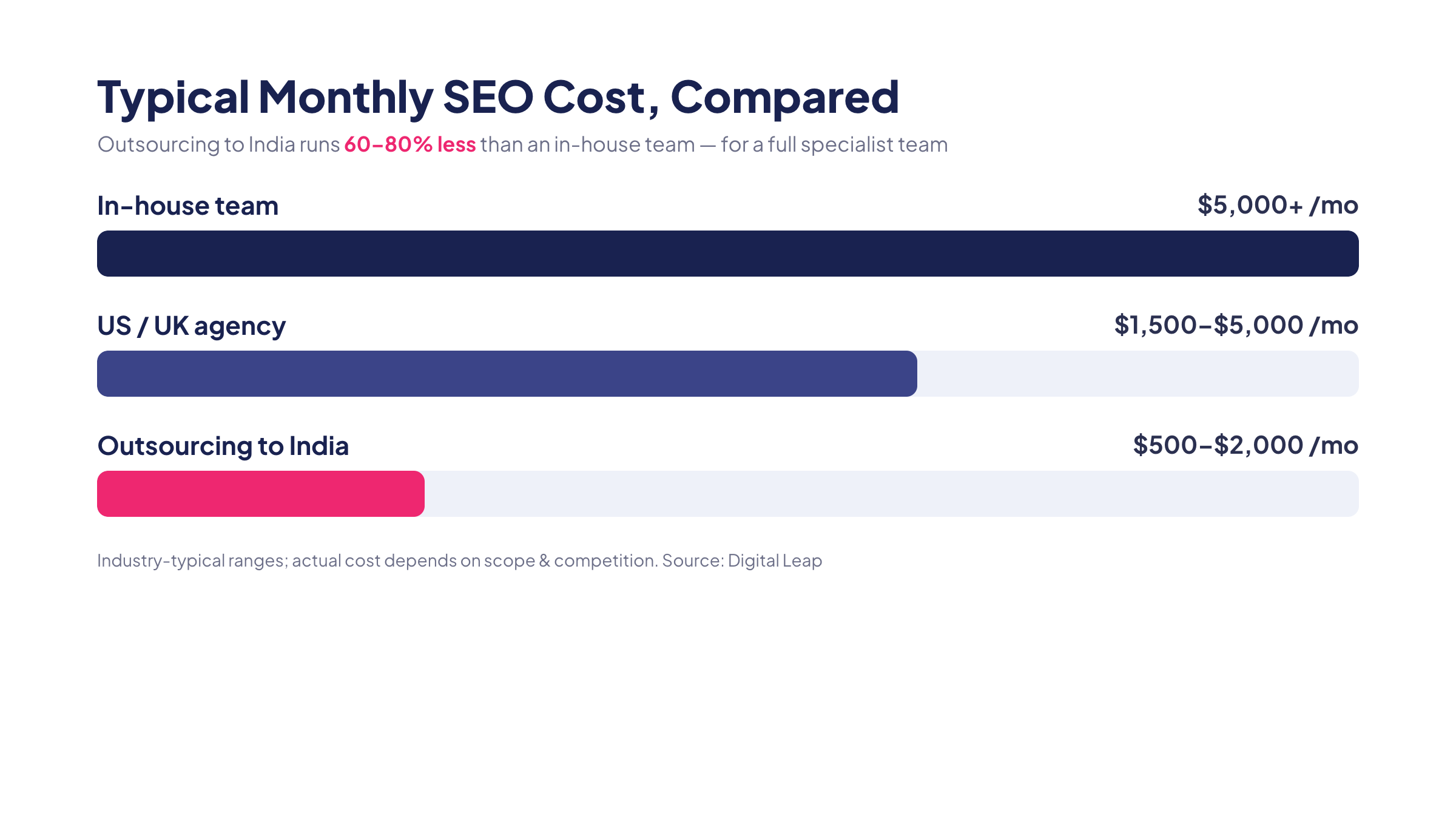
Cost is usually the deciding factor, so let’s put the three common paths side by side. These are typical US market ranges, not guarantees — actual pricing depends on scope, competitiveness, and provider quality.
| Model | Typical monthly cost | What you get |
|---|---|---|
| In-house hire (all-in) | ≈ $7,000–$9,000+ (salary, benefits, tools amortized) | One dedicated employee; limited breadth |
| US SEO agency retainer | ≈ $1,500–$5,000 | A team of specialists; higher hourly rates |
| Offshore / India outsourcing | ≈ $500–$2,000 | A specialist team at lower labor cost |
The Savings Math
Offshore outsourcing — India in particular — is commonly cited as delivering roughly 60–70% cost savings versus building or hiring domestically. The reason is straightforward: labor costs are lower, while the talent pool is large, English-proficient, and well-versed in global SEO best practices. A time-zone offset can also mean work progresses overnight relative to US hours. The savings are real, but they only translate into results when the partner is genuinely skilled — cheap-but-bad SEO can cost far more than it saves. For a deeper breakdown of pricing and process, see our guide to outsourcing SEO to India.
One more perspective: advertisers pay premium click prices for terms like “outsourcing SEO” and “in-house SEO,” which tells you how commercially valuable — and competitive — this decision is. Getting it right has real downstream revenue impact, so treat the choice as an investment decision, not just a line-item cut.
What SEO Work Can You Outsource?
Nearly every component of SEO can be delegated — and you can outsource all of it or just the pieces your in-house team can’t cover. Here’s what each area involves and why it’s commonly handed off:
- Technical SEO: site audits, crawlability, page speed, indexation, and schema markup. This is specialized, tool-heavy work that often requires developer collaboration — a natural fit for an experienced external team that fixes these issues every day.
- Keyword and content strategy: keyword research, topic mapping, and content briefs. Outsourcing this gives you access to premium research tools and competitive analysis you’d otherwise pay a subscription for.
- On-page optimization: titles, metadata, internal linking, and content structure. It’s repetitive and detail-intensive at scale, which makes it ideal to delegate once your strategy is set.
- Content production: blog posts, landing pages, and refreshes at scale. A single in-house writer can’t match the throughput of a content team, so this is one of the most commonly outsourced functions.
- Off-page and link building: earning quality backlinks and digital PR. This depends on established relationships and outreach systems that take years to build — hard to replicate with one internal hire.
- Local SEO: Google Business Profile management, citations, and review generation. Time-consuming and process-driven, it’s easy to hand to a partner who runs a proven playbook.
- E-commerce and enterprise SEO: large catalogs, faceted navigation, and international sites. The complexity here rewards specialists who have solved these problems on similar-sized sites before.
- Reporting and analytics: rank tracking, traffic analysis, and ROI measurement. Outsourced teams typically deliver structured dashboards so you can verify progress without building the reporting yourself.
The most common pattern: keep strategy and brand voice close, and outsource the labor-intensive execution — which leads directly to the hybrid model.
The Hybrid Model: Keep Strategy In-House, Outsource Execution
For a large share of growing companies, the smartest answer is not “either/or” — it’s both. In the hybrid model, you keep a lean internal owner (often a single SEO manager or marketing lead) who holds the strategy, brand voice, and priorities, and you outsource the heavy, specialized, or fluctuating execution to an external team.
Why it works so well:
- Control where it counts: your in-house owner protects brand voice and sets direction
- Breadth on demand: tap technical, content, and link specialists without hiring each one
- Cost efficiency: one internal salary plus a flexible outsourced retainer, instead of a full internal department
- Resilience: if one contributor drops off, the program keeps moving
A typical setup: an in-house manager owns the roadmap and reporting, a dedicated offshore SEO team handles technical work, content production, and link building, and the two sync weekly. You get in-house control and outsourced scale at a fraction of a full internal team’s cost.
Picture how this plays out in practice. A mid-sized US SaaS company has one marketing manager stretched across email, paid ads, and SEO. Rather than hire a $95,000 in-house specialist, they keep the manager as the strategic owner and bring on an outsourced team for execution: technical audits, eight blog posts a month, and ongoing link building. The manager spends a few hours a week directing priorities and reviewing work; the outsourced team ships the volume. The result is far more output than a single hire could produce, for roughly the cost of the tools and benefits alone — and if the company’s needs spike before a product launch, they simply scale the retainer up for a quarter, then dial it back. That flexibility is the hybrid model’s quiet superpower.
Is Outsourcing SEO (Especially to India) Safe?
Let’s address the elephant in the room honestly, because a quick search surfaces plenty of skepticism — including candid threads on Reddit and forums warning that outsourcing SEO to India “isn’t always what it’s cracked up to be.” That criticism is not baseless, and pretending otherwise would be dishonest.
Here’s the nuance: the negative reputation comes overwhelmingly from the bottom of the market — bargain providers using spammy link schemes, thin AI-spun content, or cookie-cutter tactics that can trigger penalties. That’s a quality-of-provider problem, not a country problem. India also hosts many of the world’s most sophisticated, white-hat SEO teams serving global brands. The outcome depends entirely on who you hire, not where they sit.
The real risks — and how to de-risk them:
- Quality and tactics: insist on white-hat methods. Ask exactly how they build links and produce content, and get it in writing.
- Communication: agree on cadence, tools, and reporting up front. Overlapping working hours and a named point of contact solve most friction.
- Content and language nuance: request writing samples for your market and review the first batch closely.
- Data security: use NDAs, scoped access to your accounts, and clear offboarding terms.
- Transparency: demand deliverable-level reporting so you can verify the work, not just the ranking chart.
Do that vetting and offshore outsourcing is as safe as any domestic engagement — often safer than a single unvetted freelancer. If you’re weighing regions, our comparison of outsourcing SEO to India vs the Philippines breaks down the differences.
How to Choose an SEO Outsourcing Partner
If you decide to outsource, your result rides almost entirely on partner selection. Vet on these fronts:
- Track record: case studies, references, and results in your industry or a comparable one
- Methods: a clear, white-hat explanation of how they earn rankings and links
- Communication: responsive, fluent, and structured reporting you can actually read
- Reviews and reputation: third-party ratings and verifiable client feedback
- A trial project: start small — an audit or a content sprint — before committing to a long retainer
For a fuller decision checklist, see our rundown of the top reasons to outsource your SEO and what to look for in a partner.
How Long Until Outsourced SEO Shows ROI?
Set expectations correctly regardless of model. SEO is a compounding channel, not a switch. Meaningful movement typically takes around 4–6 months, with stronger results building from there — the same broad timeline whether the work is done in-house or outsourced. Anyone promising top rankings in a few weeks is a red flag. What a capable outsourced team can do is execute more work in parallel, which often shortens the runway to visible progress. Here’s a realistic month-by-month view of what to expect:
- Months 1–3 (foundation): technical audit and fixes, keyword and competitor research, site structure improvements, and the first wave of optimized content. Expect little visible ranking movement yet — this is groundwork. Early wins may show on low-competition and long-tail terms, and you should see cleaner crawlability and indexation.
- Months 4–6 (traction): published content starts to rank, target keywords climb into more competitive positions, and organic traffic begins a measurable upward trend. Link building from the early months starts to compound, and you get a clearer read on which topics are winning.
- Months 6+ (momentum and ROI): rankings stabilize on competitive terms, organic traffic and qualified leads grow more predictably, and the earlier content and links keep paying off with minimal added cost. This is where SEO’s compounding economics show up — and where a steady outsourced retainer tends to look far more cost-efficient than a comparable in-house salary.
The takeaway: judge any SEO investment on a 6-to-12-month horizon, not a 30-day one. The model that lets you sustain consistent execution across that window — without budget strain or a single point of failure — is usually the one that wins.
In-House or Outsource? A Quick Decision Framework
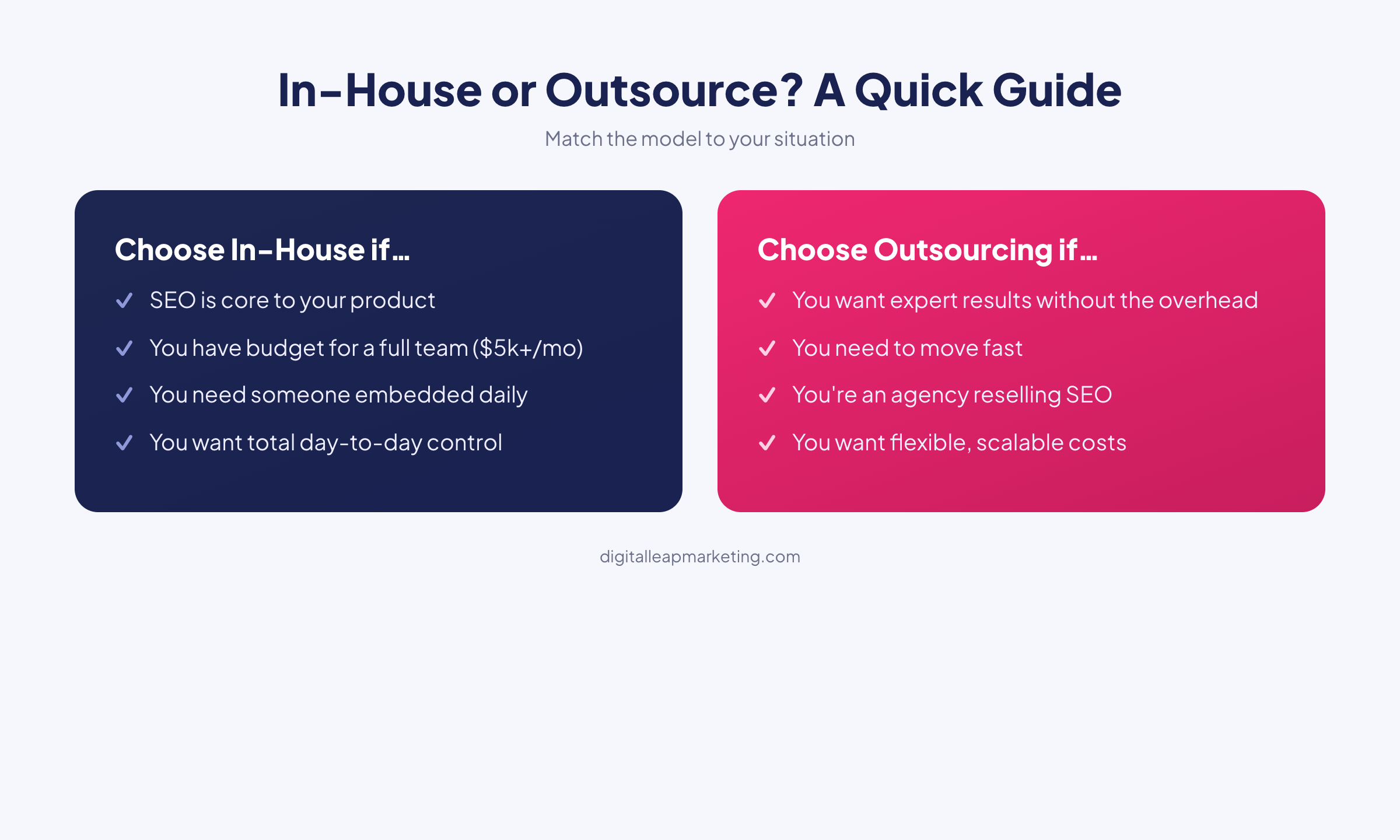
Run your situation through these prompts. Most of your answers pointing one direction is your signal.
Lean In-House If…
- SEO is a core, permanent driver of your business
- You have steady, high-volume work to keep a full-time hire busy
- You need daily, tight integration with product and engineering
- Your budget comfortably covers salary, benefits, and tools
Lean Outsourcing If…
- You need broad expertise faster than you can hire it
- You want predictable costs without payroll and tool overhead
- Your workload varies and you value the ability to scale
- You’re an agency wanting to offer SEO without building a department — a white-label SEO partner fits perfectly
Go Hybrid If…
- You want strategic control but can’t fund a full internal team
- You have an internal owner but need specialist execution
- You want cost efficiency without giving up brand voice
Frequently Asked Questions
How much does SEO cost in India?
Monthly SEO retainers from India-based providers commonly range from ≈ $500 to $2,000, depending on scope, competitiveness, and the provider’s quality. That’s typically well below US agency retainers of ≈ $1,500–$5,000/month, which is why cost savings of roughly 60–70% are frequently cited. As always, price should be weighed against demonstrated quality and white-hat methods.
How much does it cost to outsource SEO to India?
It varies by engagement model. Project-based work (like a one-off audit) may be a few hundred dollars, while ongoing retainers commonly run ≈ $500–$2,000/month. Dedicated-team and white-label arrangements are usually priced by scope and volume. Compared with an all-in US in-house hire — commonly $85,000+ per year once salary, benefits, and tools are included — outsourcing is typically far more cost-efficient for most SMBs.
Is SEO dead or evolving in 2026?
SEO is evolving, not dead. AI Overviews and answer engines are changing how results appear, which raises the value of genuinely helpful content, strong technical foundations, and demonstrated expertise. Organic search remains a major, high-intent traffic source — the tactics shift, but the discipline of earning visibility is very much alive.
What are the 4 types of SEO?
The four commonly cited types are: on-page SEO (optimizing content and page elements), off-page SEO (backlinks and reputation), technical SEO (crawlability, speed, and structure), and local SEO (visibility for location-based searches). A complete program addresses all four, which is a key reason many businesses outsource — few single hires cover every area equally well.
The Bottom Line
There’s no universally “right” answer — only the right fit for your budget, growth stage, and how central search is to your business. In-house buys control and deep brand knowledge at a high fixed cost. Outsourcing buys speed, breadth, and flexibility at a lower, variable cost. And for many growing companies, the hybrid approach captures the best of both.
If outsourcing or a hybrid setup sounds right for you, we can help. Digital Leap is an India-based SEO agency helping US businesses and agencies scale organic growth with white-hat, transparent execution. Explore our SEO outsourcing services or book a free, no-pressure consultation to map out the model that fits your goals.
Related: Not sure who to hire? See our ranked comparison of the best SEO outsourcing companies in India for 2026.