
You have a business to run, and you already know that search engine optimization is one of the highest-leverage things you can invest in. The problem is that building an in-house SEO team in the United States is slow and expensive, freelancers are hit-or-miss, and full-service US agencies can quietly eat $3,000 to $10,000 a month before you see a single ranking move. That math is exactly why so many American founders, marketers, and agency owners start looking overseas — and why India keeps coming up as the destination of choice.
But outsourcing SEO to India also carries a reputation problem. Search the topic on Reddit and you will find plenty of horror stories about spammy links, copy-paste reports, and agencies that promise a number-one ranking in 30 days. Both things are true at once: India is home to some of the best SEO talent in the world and some of the worst offenders. This guide is written for US-based buyers who want the upside without the landmines. We will cover what outsourcing actually involves, what it costs in 2026, a seven-step process to do it safely, and the exact red flags that separate a real partner from a rank-and-run vendor.
What Does Outsourcing SEO to India Actually Mean?
Outsourcing SEO to India means hiring an India-based agency, team, or specialist to plan and execute your search engine optimization — from technical fixes and keyword research to content and link building — instead of doing it in-house. US companies typically choose India for its large, English-proficient talent pool and costs that commonly run 60–70% below equivalent US rates.
The word “outsourcing” hides a lot of variety, though. Before you shortlist anyone, it helps to know which engagement model you actually need, because the model determines how much you manage, how much you pay, and how much risk you carry.
The 5 Common Engagement Models
- Full-service agency. The India partner owns strategy and execution end to end. Best for business owners who want to hand off SEO entirely and judge on results.
- Dedicated team / staff augmentation. You “rent” one or more specialists who work as an extension of your team, on your tools and your schedule. Best for companies that want control without the hiring overhead.
- White-label / SEO reseller. The India agency does the work invisibly under your brand, and you resell it to your own clients. This is the model most US agencies use — if that is you, see our guide to white-label SEO.
- Project-based. A one-off scope such as a technical audit, a site migration, or a content sprint, with a fixed deliverable and price.
- Employer of Record (EOR). You legally build a remote team in India through a third party that handles payroll and compliance. Best for scaling a long-term offshore function.
What You Can Actually Outsource
Almost every component of a modern SEO program can be delegated, either individually or as a package:
- Technical SEO — crawlability, site speed, indexation, and schema markup
- On-page SEO and content optimization
- Keyword research and strategy
- Content creation and editing
- Off-page SEO and link building
- Local SEO and Google Business Profile management
- E-commerce and enterprise SEO
- Audits, analytics, and monthly reporting
You do not have to outsource all of it at once. Many US companies keep strategy and brand voice in-house and delegate only the labor-intensive pieces — technical fixes, content production, and link building — where offshore economics make the biggest difference. Others hand off the entire function. The right split depends on your internal capacity and how much oversight you want to retain, and a good partner will adapt to either arrangement rather than forcing you into a fixed package.
Why US Companies Outsource SEO to India
The cost savings get the headlines, but they are only one of several reasons India has become a default choice for offshore SEO. The full picture looks like this:
- Cost efficiency. Indian agency rates commonly run 60–70% below comparable US pricing, which lets a small US business afford a full team rather than a single part-time freelancer.
- Deep, English-proficient talent pool. India is one of the largest English-speaking professional workforces in the world and a long-established hub for digital services, so specialist skills are abundant.
- Time-zone advantage. The roughly 9.5–12.5 hour offset from US time zones means work can progress overnight and land on your desk in the morning — effectively a second shift.
- Scalability. Ramping a team from one specialist to five is far faster and cheaper offshore than recruiting locally.
- Focus on your core business. Handing execution to a dedicated partner frees your internal team to work on product, sales, and customers.
If you are still weighing whether to build internally or hand it off, our breakdown of in-house SEO vs. outsourcing walks through the trade-offs in detail, and our overview of the benefits of outsourcing SEO covers the strategic upside.
How Much Does It Cost to Outsource SEO to India in 2026?
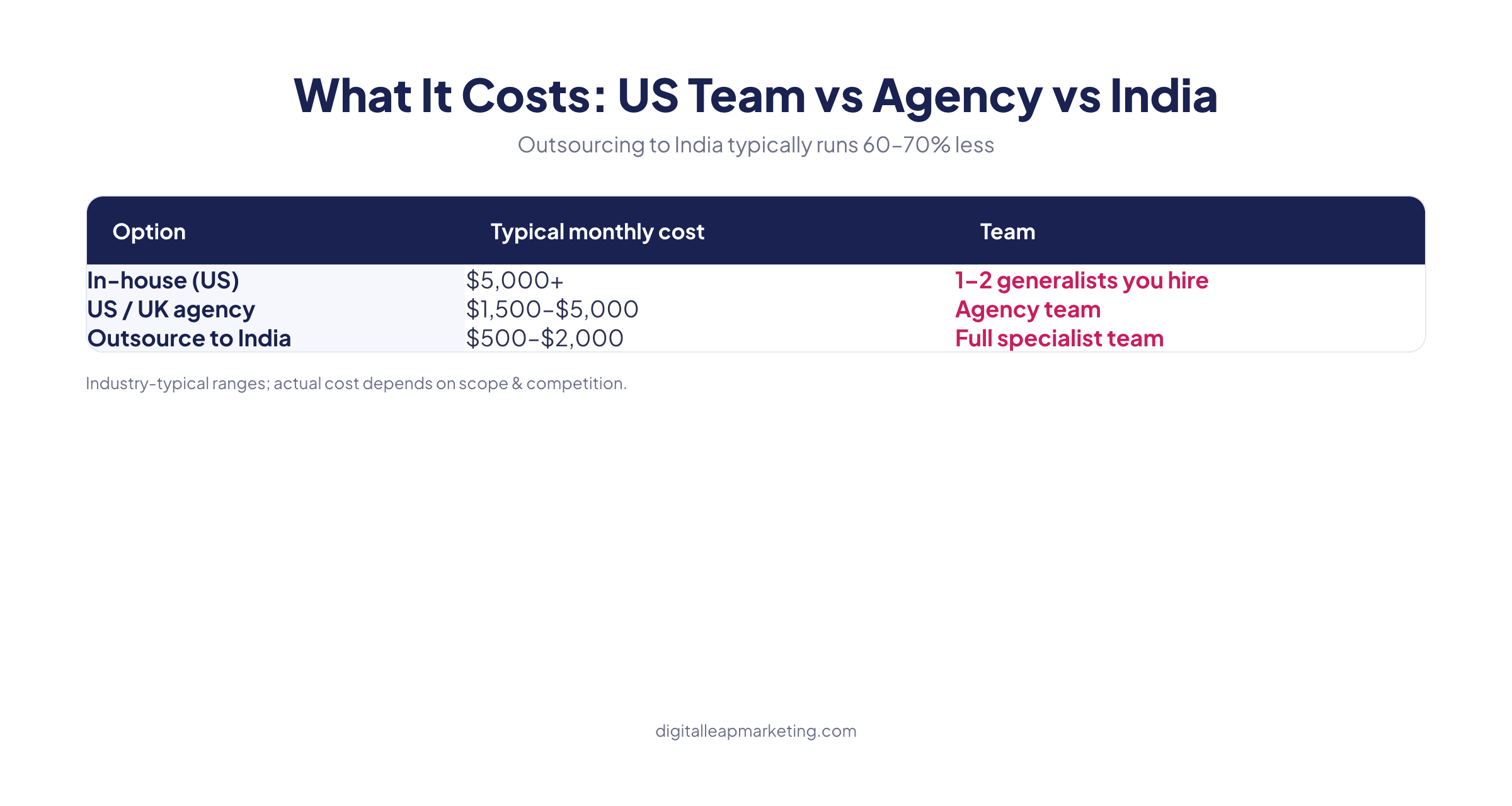
Outsourcing SEO to India typically costs 60–70% less than hiring a US agency. Indian agency retainers commonly range from roughly $500 to $2,500 per month, versus $2,500 to $10,000+ for a comparable US agency and $6,000+ per month for a single in-house US hire once salary and overhead are included. Exact pricing depends on scope, competitiveness, and seniority.
The numbers below are industry-standard ranges rather than fixed quotes — treat them as a planning baseline, and always confirm scope before comparing. The key insight is not just the lower sticker price but what that price buys: with an India partner, a mid-market budget often covers a whole team (strategist, content, technical, and links) rather than a fraction of one senior US practitioner.
| Option | Typical monthly cost (USD) | What you get | Best for |
|---|---|---|---|
| In-house US hire | $5,000–$8,000+ (salary + overhead) | One person; limited coverage across all SEO disciplines | Large brands needing full-time internal control |
| US agency / freelancer | $2,500–$10,000+ | Full team, premium pricing, same-time-zone comms | Enterprises with big budgets and complex needs |
| India agency (full-service) | $500–$2,500 | Full team output at a fraction of the cost | SMBs, startups, and agencies reselling SEO |
| India dedicated specialist | $800–$2,000 | One or more embedded team members on your tools | Companies wanting control without US hiring costs |
A word of caution: the cheapest tier — the $99-a-month “SEO packages” you will see advertised — is almost always automated, low-quality link spam that can actively harm your site. Quality has a floor, and it is well above rock-bottom pricing.
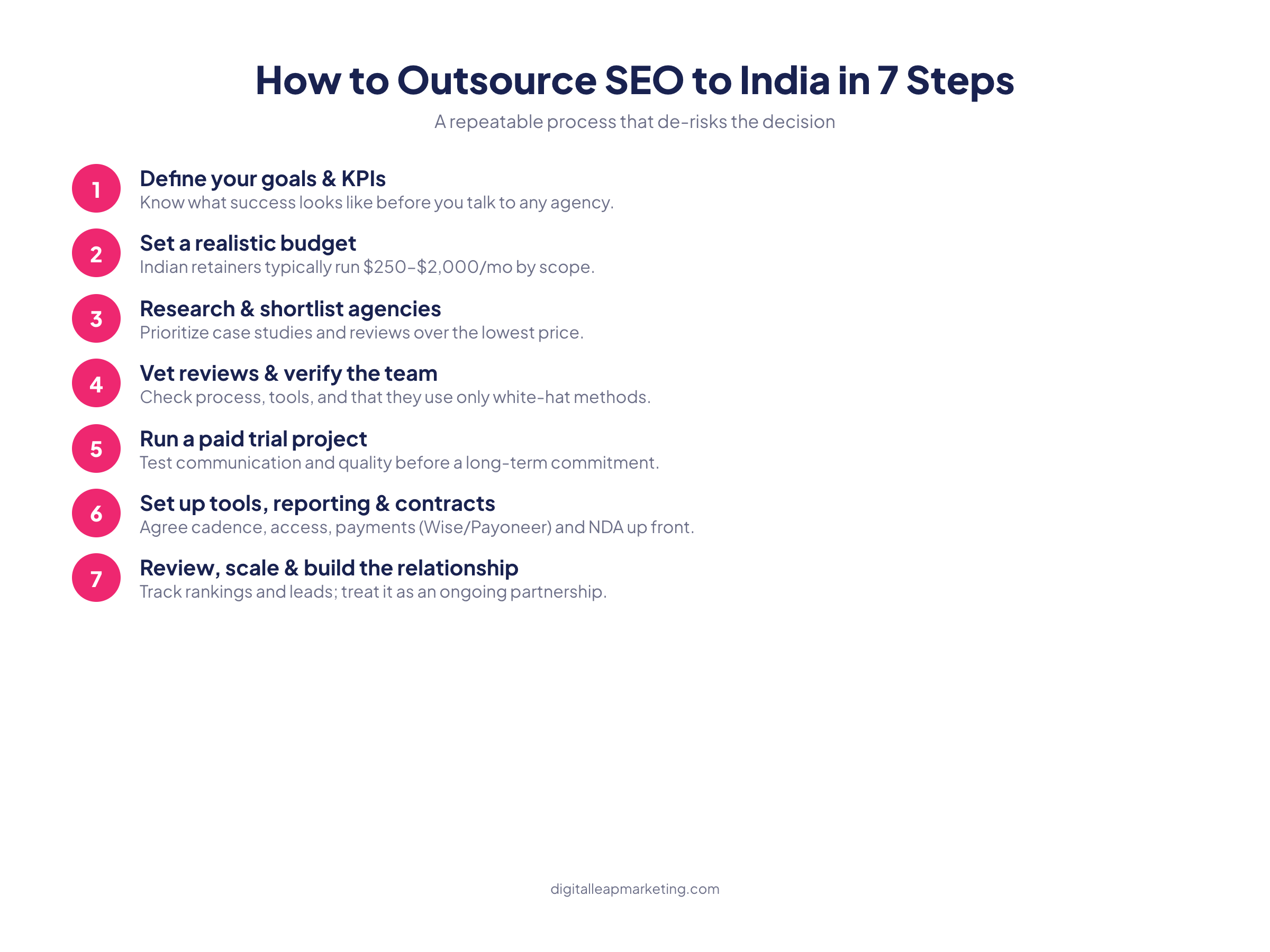
How to Outsource SEO to India: A 7-Step Process
Doing this well is a process, not a purchase. Follow these seven steps and you will filter out most of the risk before you ever sign a contract. For a broader walkthrough beyond India specifically, see our complete SEO outsourcing guide.
Step 1: Define Your Goals and KPIs
Before you contact anyone, decide what success looks like. Are you chasing organic traffic, qualified leads, local visibility, or e-commerce revenue? Write down two or three measurable KPIs (for example, “double organic leads in nine months”) and your target keywords or markets. Vague goals produce vague results and make it impossible to hold a partner accountable.
Step 2: Research and Shortlist Indian Agencies
Build a shortlist of five to eight agencies from a mix of sources: Google (an SEO company that cannot rank itself is a red flag), directories like Clutch and DesignRush, LinkedIn, and referrals. Prioritize firms that publish real case studies and work openly with US clients over anyone whose pitch is built entirely around being cheap.
Step 3: Vet Reviews, Case Studies, and the Team
Dig into third-party reviews (Clutch and Google, not just testimonials on their own site), ask for case studies in your industry, and verify the team is real — named people with LinkedIn profiles, not a faceless “50+ experts” claim. Ask who will actually do your work and whether any of it is sub-outsourced further down the chain.
Step 4: Interview and Assess Communication
Get on a video call. You are evaluating clarity of communication, honesty about timelines, and whether they ask smart questions about your business. Confirm how much overlap they offer with US business hours — a good India partner will commit to a few hours of daily overlap and a predictable reporting rhythm, so the time-zone gap becomes an asset instead of a frustration.
Step 5: Run a Paid Trial Project
Never sign a 12-month retainer cold. Start with a small paid trial — a technical audit, a keyword and content plan, or a batch of optimized pages. A simple one-page scope of work should state the deliverable, the deadline, the price, and how you will judge quality. The trial tells you more about a partner than any sales call ever will.
Score the trial on more than the final deliverable. Did they hit the deadline? Was communication proactive or did you have to chase updates? Did the work show real understanding of your business, or was it a generic template with your name swapped in? A partner who over-communicates and slightly over-delivers on a small trial is very likely to do the same at scale — and one who goes quiet or cuts corners on the audition rarely improves once the contract is signed.
Step 6: Set Up Tools, Reporting, Contracts, and Payments
Agree on your stack (Google Analytics, Search Console, Ahrefs or Semrush, a shared project board) and a monthly reporting cadence tied to your KPIs. Put a contract in place that covers scope, confidentiality, and IP ownership of the content and assets created. For payments, international tools like Wise and Payoneer keep fees low, and US companies should collect a Form W-8BEN or W-8BEN-E from the vendor for tax documentation.
Step 7: Review, Scale, and Build the Relationship
Review performance against your KPIs every month for the first quarter, then adjust scope. SEO compounds, so the partners who deliver the most value are usually the ones you keep for years, gradually expanding from a trial into a full program. Treat a strong offshore team as a long-term extension of your business, not a disposable vendor.
Is Outsourcing SEO to India Safe? Red Flags vs. Green Flags
This is the question that keeps US buyers up at night, and it deserves an honest answer: yes, it is safe — if you vet properly. The bad reputation is real but comes from a specific slice of low-cost, high-volume vendors, not from the country as a whole. Learning to read the signals is the single most valuable skill in this process. We cover the full list in our guide to SEO outsourcing mistakes to avoid, but here are the essentials.
Red Flags to Walk Away From
- Guaranteed number-one rankings or “results in 30 days” — no legitimate agency can promise this.
- Suspiciously cheap link packages (hundreds of backlinks for $50), which signal spam networks that risk a Google penalty.
- No transparent reporting, or reports full of vanity metrics instead of traffic, rankings, and leads.
- Vague, evasive answers about their link-building methods.
- No named team, no verifiable case studies, and pressure to sign a long contract immediately.
Green Flags That Signal a Real Partner
- Transparent, KPI-based monthly reporting and access to your own analytics accounts.
- Clearly white-hat methods and a willingness to explain exactly how they earn links and build content.
- Verifiable case studies, real named team members, and references you can contact.
- A willingness to start with a small trial rather than demanding a long commitment.
- Clear contracts covering confidentiality, data security, and IP ownership.
On data security specifically, insist on a signed NDA, scoped access to your accounts (never share master passwords), and a clause that assigns ownership of all created content and assets to you. Protecting payments is equally simple: pay in milestones tied to deliverables rather than large sums up front.
India vs. the Philippines and Other Destinations
India is not the only offshore option — the Philippines, in particular, is a popular alternative, and the two differ on cost, technical depth, English style, and time-zone fit. Rather than repeat the full comparison here, we have dedicated a complete breakdown to it: read outsourcing SEO to India vs. the Philippines to see which fits your priorities. In short, India tends to lead on technical and link-building depth and sheer scale of specialist talent, while the Philippines is often favored for content support and closer cultural alignment with US communication styles.
Real ROI: When Will You See Results?
Set expectations early, because unrealistic timelines are where most outsourcing relationships sour. SEO is a compounding investment, not a switch you flip. Most sites begin to see meaningful movement in rankings and traffic within three to six months, with the largest gains typically arriving between months six and twelve as content matures and links accumulate. Competitive niches take longer; a brand-new domain takes longer still.
The ROI case for offshoring is straightforward: because your cost base is 60–70% lower, the traffic and leads you generate reach breakeven far sooner than they would with a premium US agency. A modest, sustained India retainer that produces a steady stream of organic leads will usually outperform a larger US budget on a pure return basis — provided the work is genuinely high quality, which loops right back to vetting.
To keep the relationship pointed at ROI rather than activity, tie your monthly review to outcomes you actually care about — organic traffic, keyword rankings for your money pages, and, above all, leads or revenue — instead of vanity metrics like the raw number of links built or blog posts published. The best offshore partners will happily report against those business outcomes, because it is how they prove their value and earn a long-term contract.
SEO Outsourcing in 2026: AI, AEO, and E-E-A-T
The discipline you are outsourcing is changing fast, so make sure your partner is keeping up. Three shifts matter most in 2026. First, AI Overviews and AI-driven search now sit above traditional results for many queries, which makes answer engine optimization (AEO) — structuring content so machines can extract and cite it — a core skill rather than a nice-to-have. Second, Google’s emphasis on E-E-A-T (experience, expertise, authoritativeness, and trust) rewards genuinely helpful, credible content over thin, keyword-stuffed pages. Third, AI tooling has raised the baseline for productivity, so a good partner should be using AI to work faster while a human still owns strategy and quality. When you interview an India agency, ask how they approach all three; a firm still selling 2018-era tactics is a firm to avoid.
Frequently Asked Questions
How much does SEO cost in India?
SEO in India commonly costs between roughly $500 and $2,500 per month for a full-service agency retainer, with dedicated specialists in a similar range. Pricing depends on scope, industry competitiveness, and seniority. Expect to pay more for enterprise or highly competitive niches, and treat sub-$100 “packages” as a warning sign of automated spam.
How much does it cost to outsource to India overall?
Outsourcing SEO to India typically costs 60–70% less than the equivalent work done by a US agency or in-house hire. In practice, a mid-market budget that buys a fraction of one senior US practitioner can fund an entire India-based team covering strategy, content, technical SEO, and link building — which is the core of the value proposition.
What are the 4 types of SEO?
The four core types of SEO are on-page SEO (optimizing content and page elements), off-page SEO (links and external authority), technical SEO (crawlability, speed, and structure), and local SEO (visibility in map and location-based results). A complete India SEO program should cover all four, and you can outsource them individually or as a bundle.
What is the 80/20 rule in SEO?
The 80/20 rule (the Pareto principle) in SEO means that roughly 80% of your results come from about 20% of your efforts — usually a small set of high-value pages, target keywords, and quality links. A good outsourcing partner focuses resources on that high-impact 20% rather than spreading thin effort across everything at once.
How can I get international SEO clients?
US agencies and freelancers commonly win international clients through referrals, directories like Clutch, LinkedIn outreach, and by ranking their own content. Many then use a white-label India partner to fulfill the work profitably. Our white-label SEO services for agencies are built for exactly this resale model.
Is SEO dead or still worth it in 2026?
SEO is not dead in 2026 — it is evolving. AI Overviews and answer engines have changed how results appear, but search remains a primary way people find businesses, and organic visibility is still one of the highest-ROI marketing channels. The tactics that win now emphasize helpful content, E-E-A-T, and answer engine optimization rather than old-school keyword stuffing.
Ready to Outsource SEO the Right Way?
Outsourcing SEO to India can give a US business enterprise-grade execution at a fraction of the cost — but only when you choose a transparent, white-hat partner and follow a disciplined process. At Digital Leap, we are an India-based SEO agency built specifically for US clients, with real reporting, named specialists, US-hours overlap, and a trial-first approach so you can judge the work before you commit. If you would like to see what a proper offshore SEO program looks like, explore our SEO outsourcing services or reach out for a free, no-pressure consultation and audit of your site.
Related: Not sure who to hire? See our ranked comparison of the best SEO outsourcing companies in India for 2026.