Digital marketing for the healthcare industry is the use of online channels such as SEO, content marketing, paid advertising, social media, email marketing, and reputation management to help healthcare organizations attract, educate, and engage patients. It helps hospitals, clinics, and medical practices improve visibility, build trust, and connect with patients throughout their healthcare journey.
Healthcare has changed how patients find and choose providers. Today, many people search online before booking an appointment, comparing healthcare services, reading reviews, and researching providers.
A strong digital marketing strategy helps healthcare organizations appear where patients are looking and provide the information they need to make confident decisions.
What Is Digital Marketing for the Healthcare Industry?
Digital marketing for healthcare is the process of promoting healthcare services through digital platforms to reach and engage potential and existing patients.
Unlike traditional healthcare marketing, digital marketing allows organizations to connect with patients at different stages, from discovering a health concern to choosing a provider and scheduling care.
The main digital marketing channels used in healthcare include:
- Healthcare SEO: Improving online visibility for healthcare-related searches.
- Content Marketing: Creating helpful information about conditions, treatments, and healthcare services.
- Local SEO: Helping patients find nearby clinics, doctors, and healthcare providers.
- Paid Advertising: Using platforms like Google Ads and social media ads to reach high-intent audiences.
- Social Media Marketing: Sharing educational content and building patient trust.
- Email Marketing: Supporting patient communication and engagement.
- Online Reputation Management: Managing reviews and building credibility.
- AI Search Optimization: Improving content visibility across AI-powered search experiences like Google AI Overviews, ChatGPT, Gemini, and Perplexity.
The goal of digital marketing in the healthcare industry is not only to increase traffic. It is to help the right patients find the right healthcare services.
Why Is Digital Marketing Important in Healthcare?
Patients now use digital channels to research symptoms, treatments, providers, and healthcare facilities before making decisions.
A healthcare organization with a strong online presence can improve visibility, educate patients, and build trust before the first interaction.
Digital marketing helps healthcare businesses:
- Reach patients searching for specific healthcare services
- Improve online visibility through search engines
- Build trust through accurate and helpful information
- Increase appointment inquiries and bookings
- Educate patients about treatments and conditions
- Maintain communication with existing patients
- Strengthen brand reputation
For example, a patient searching for “dermatologist near me” or “physical therapy for back pain” is already looking for a solution. A strong digital presence helps healthcare providers appear during this decision-making process.
How Does Digital Marketing Help Healthcare Organizations?
Digital marketing supports healthcare organizations throughout the complete patient journey. From the first online search to appointment scheduling and ongoing communication, each marketing channel can improve the patient experience and support business growth.
Hospitals, clinics, and medical practices can use digital marketing to improve discoverability, strengthen credibility, and create more effective patient connections.
Helps Patients Find Healthcare Services
Most healthcare journeys begin with online research. Patients use Google Search, Google Maps, healthcare directories, and provider websites to find information about services and providers.
A strong digital presence helps healthcare organizations appear for relevant searches, including:
- Medical services
- Health conditions
- Treatment options
- Local providers
- Healthcare questions
For example, a clinic offering dermatology services can create optimized pages for acne treatment, skin cancer screening, or cosmetic procedures to reach patients searching for those specific services.
Builds Trust Through Healthcare Content
Trust is one of the most important factors in the healthcare sector. Patients want confidence that they are choosing a knowledgeable and reliable provider.
Digital marketing helps healthcare organizations demonstrate expertise through:
- Educational articles
- Treatment pages
- Provider profiles
- Patient FAQs
- Reviews and testimonials
- Healthcare resources
Healthcare content should follow strong E-E-A-T principles by showing experience, expertise, authority, and trustworthiness.
Because healthcare websites fall under YMYL (Your Money or Your Life), accurate information and credible sources are especially important.
Improves Patient Acquisition and Engagement
Digital marketing helps healthcare providers attract new patients while maintaining relationships with existing ones.
A typical patient journey looks like:
Awareness → Research → Trust → Appointment → Retention
Different marketing channels support different stages:
Awareness
- Social media
- Educational content
- Healthcare advertising
Research
- SEO
- Service pages
- Healthcare blogs
Trust
- Reviews
- Provider information
- Patient testimonials
Decision
- Landing pages
- Online booking
- Appointment information
Retention
- Email communication
- Patient education
- Follow-up resources
A successful healthcare marketing strategy focuses on creating valuable patient experiences instead of only generating traffic.
Supports Better Patient Education
Many patients search online because they want to understand their symptoms, treatment options, and healthcare choices before contacting a provider.
Healthcare organizations can use digital marketing to provide helpful information through:
- Blog content
- FAQs
- Videos
- Treatment explanations
- Condition guides
- Patient resources
For example, a physical therapy clinic can create educational content about injury recovery, while a medical practice can explain common treatment options for specific conditions.
This helps patients make more informed decisions and builds confidence in the healthcare provider.
Helps Healthcare Brands Compete Online
The healthcare industry is highly competitive, with many providers offering similar services in the same locations.
Digital marketing allows healthcare organizations to differentiate themselves through:
- Strong online visibility
- Helpful healthcare content
- Positive patient reviews
- Clear service information
- Provider expertise
A consistent online presence helps patients understand why a specific healthcare provider may be the right choice for their needs.
Digital Marketing Strategies for Healthcare Industry
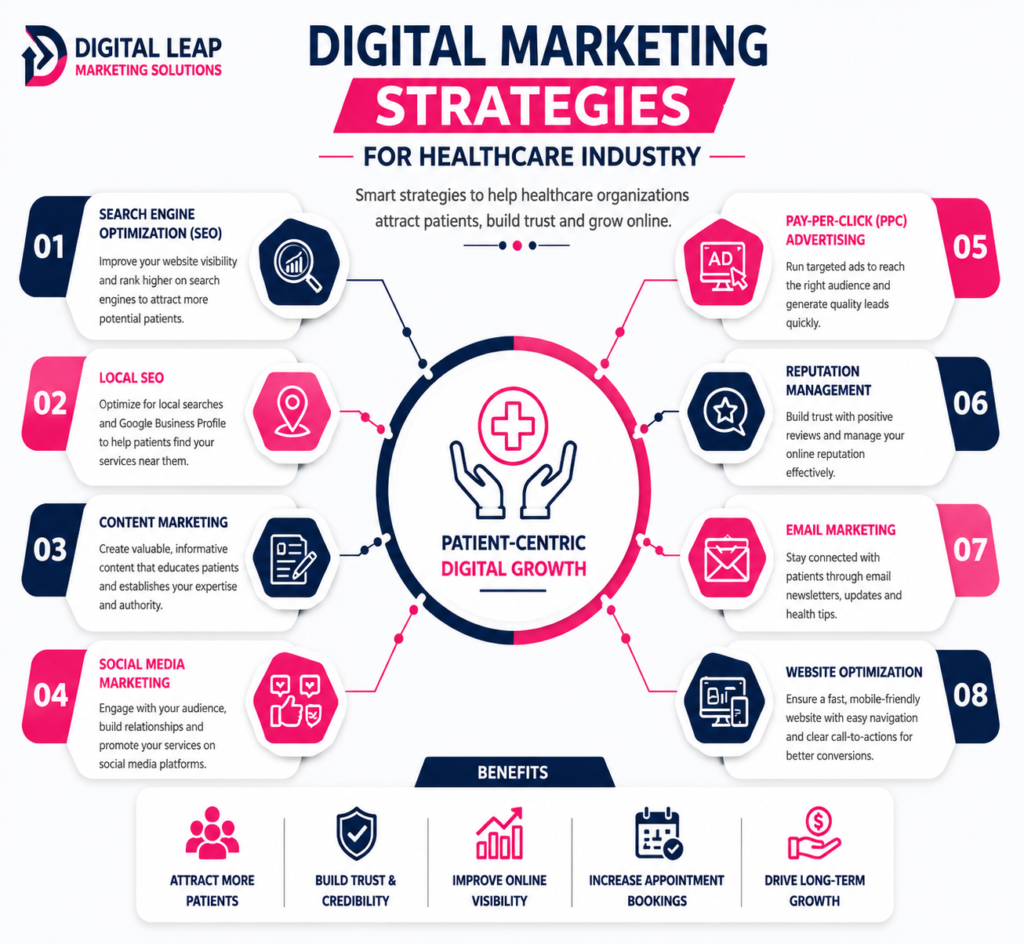
Digital marketing strategies for the healthcare industry help hospitals, clinics, medical practices, and healthcare organizations connect with patients through different online channels. A successful healthcare digital marketing approach combines search visibility, patient education, paid campaigns, reputation management, and communication strategies to support the complete patient journey.
The right strategy depends on factors such as healthcare specialty, target patients, location, competition, budget, and business goals. Instead of focusing on one channel, healthcare organizations should create an integrated approach where each marketing activity supports the others.
Healthcare SEO
Healthcare SEO helps healthcare organizations improve visibility in search results when patients search for medical services, treatments, symptoms, and providers.
Patients often begin their healthcare journey on Google by searching questions such as:
- “Dermatologist near me”
- “Best physical therapy clinic”
- “How to treat acne scars”
- “Telehealth provider for primary care”
A strong healthcare SEO strategy helps medical websites appear for these searches by improving website structure, content quality, and search relevance.
Key areas of healthcare SEO include:
- Healthcare keyword research: Identifying the terms patients use when searching for services, conditions, and treatments.
- Service page optimization: Creating detailed pages for individual treatments and healthcare services.
- Medical content creation: Publishing accurate articles, FAQs, and guides that answer patient questions.
- Technical SEO: Improving website performance, crawlability, indexing, and user experience.
- On-page SEO: Optimizing titles, headings, content structure, internal links, and page elements.
- Local SEO: Improving visibility for location-based searches.
- E-E-A-T optimization: Demonstrating healthcare expertise, experience, authority, and trust.
For example, a dermatology practice can create dedicated pages for acne treatment, Botox, skin cancer screening, and laser treatments instead of relying only on a general service page.
Healthcare SEO helps organizations build long-term organic visibility and attract patients who are actively searching for healthcare solutions.
Local SEO for Healthcare Providers
Local SEO helps healthcare organizations appear when patients search for nearby providers, clinics, hospitals, and medical services.
Many healthcare decisions are location-based. Patients often search for providers within their area because accessibility and convenience influence their choice.
A strong local SEO strategy includes:
- Optimizing Google Business Profile
- Maintaining accurate business information
- Collecting genuine patient reviews
- Creating location-specific service pages
- Managing healthcare directory listings
- Building local relevance through content
For example, a physical therapy clinic in Chicago should optimize its online presence for relevant local searches such as “physical therapist in Chicago” or “sports rehabilitation clinic near me.”
Local SEO helps healthcare businesses improve visibility on Google Search and Google Maps while building trust with potential patients.
Healthcare Content Marketing
Healthcare content marketing focuses on creating helpful and accurate information that supports patients during their research process.
Patients often look for answers before contacting a healthcare provider. They want to understand symptoms, treatment options, procedures, and what to expect during care.
Healthcare organizations can create:
- Blog articles
- Treatment guides
- Condition pages
- Patient FAQs
- Videos
- Healthcare resources
Examples include:
- “What Are the Early Signs of Skin Cancer?”
- “How Does Physical Therapy Help Back Pain?”
- “What Should Patients Expect During a Telehealth Visit?”
High-quality healthcare content supports SEO, improves patient education, and strengthens trust.
Because healthcare content falls under YMYL topics, organizations should prioritize accuracy, expert review, and reliable information.
Paid Advertising and Healthcare PPC
Paid advertising helps healthcare organizations reach patients who are actively searching for specific medical services, treatments, and providers. Unlike SEO, which builds organic visibility over time, healthcare PPC can help hospitals, clinics, and medical practices appear quickly for high-intent searches.
Healthcare organizations can use paid advertising platforms such as:
- Google Ads
- Microsoft Ads
- Meta Ads
- LinkedIn Ads
Healthcare PPC campaigns can target:
- Specific medical services
- Specialty treatments
- Healthcare locations
- Patient needs and search intent
Examples:
- A dental clinic promoting emergency dental services
- A med spa promoting Botox consultations
- A hospital promoting a specialized treatment program
- A physical therapy clinic promoting injury recovery services
A successful healthcare advertising campaign requires:
- Relevant keyword targeting
- Clear ad messaging
- Dedicated landing pages
- Conversion tracking
- Location and audience targeting
- Compliance-focused healthcare messaging
The goal of healthcare PPC is not only to generate clicks but to attract qualified patient inquiries, consultation requests, and appointment bookings.
Social Media Marketing for Healthcare
Social media marketing helps healthcare organizations educate patients, increase awareness, and build stronger relationships.
Platforms such as Instagram, Facebook, YouTube, LinkedIn, and TikTok allow healthcare providers to share valuable information and showcase their expertise.
Healthcare social media content may include:
- Health education posts
- Provider introductions
- Treatment explanations
- Patient FAQs
- Behind-the-scenes practice content
- Healthcare awareness campaigns
For example, a dermatologist can use Instagram videos to explain skincare concerns, while a physical therapy clinic can share educational exercises and recovery tips.
Social media works best when it focuses on education and trust rather than direct promotion only.
Email Marketing and Patient Engagement
Email marketing helps healthcare organizations maintain communication with patients after the initial interaction.
It can support:
- Appointment reminders
- Health education
- Follow-up communication
- Newsletters
- Patient updates
For example, a dermatology practice may send skincare education emails, while a healthcare clinic may share preventive care information.
Email marketing supports patient engagement by keeping healthcare organizations connected with their audience.
Healthcare businesses should ensure email communication follows applicable privacy and consent requirements.
Online Reputation Management
Online reputation management helps healthcare providers build trust by managing how patients perceive their practice online.
Before choosing a healthcare provider, many patients review:
- Google reviews
- Patient testimonials
- Provider information
- Online ratings
A reputation management strategy includes:
- Encouraging genuine patient feedback
- Responding professionally to reviews
- Monitoring online mentions
- Improving patient experience
Positive reviews can influence patient decisions and support local search visibility.
AI Search Optimization (AEO and GEO)
AI search optimization helps healthcare organizations improve how their content is understood and displayed in AI-powered search experiences. It focuses on creating clear, structured, and trustworthy healthcare information that can be easily interpreted by platforms such as Google AI Overviews, ChatGPT, Gemini, and Perplexity.
Patients are increasingly using AI-powered tools to find answers about symptoms, treatments, healthcare providers, and medical services. Healthcare websites can improve their visibility in these experiences by creating content that directly answers patient questions.
Healthcare organizations can improve AI search visibility by creating content that is:
- Clear and direct
- Well-structured with proper headings
- Supported by healthcare expertise
- Organized with FAQs and question-based content
- Focused on answering specific patient needs
- Updated with accurate and reliable information
For example, instead of only creating a page about “Botox Treatment,” a healthcare website can create content that answers:
- What is Botox?
- How does Botox work?
- Who is a suitable candidate for Botox?
- What should patients expect during the treatment?
- How long do Botox results last?
This approach helps search engines and AI systems better understand the topic, context, and expertise behind the content, making healthcare information easier for patients to discover.
How to Build a Digital Marketing Strategy for Healthcare
A digital marketing strategy for healthcare helps hospitals, clinics, medical practices, and healthcare organizations create a structured approach to attract, educate, and engage patients. It combines different channels such as healthcare SEO, content marketing, paid advertising, social media, and reputation management to achieve specific growth goals.
A successful strategy should focus on reaching the right patients, providing useful information, building trust, and measuring results based on meaningful outcomes such as inquiries and appointments.
Define Your Target Patients
The first step is understanding who you want to reach. Healthcare organizations should identify their ideal patients, their healthcare needs, search behavior, and the factors that influence their provider decisions.
Consider:
- Patient demographics and location
- Services or treatments they need
- Questions they search online
- Challenges they face before choosing a provider
For example, a dermatology clinic may target patients searching for acne treatment or skin cancer screening, while a physical therapy clinic may focus on people looking for injury recovery solutions.
Set Clear Marketing Goals
Clear goals help healthcare organizations choose the right marketing activities and measure success.
Common healthcare marketing goals include:
- Increasing appointment requests
- Improving search visibility
- Promoting specific healthcare services
- Building patient trust
- Increasing patient engagement
Each goal requires a different approach. For example, a new medical practice may focus on local SEO and brand awareness, while an established clinic may focus on improving patient retention and promoting new services.
Choose the Right Marketing Channels
Healthcare organizations should select marketing channels based on their goals, audience, services, and competition.
Common channels include:
- Healthcare SEO: Improves visibility when patients search for healthcare services, conditions, and providers.
- Local SEO: Helps nearby patients discover clinics and medical practices through Google Search and Google Business Profile.
- Content Marketing: Provides helpful information about treatments, conditions, and healthcare services.
- PPC Advertising: Reaches patients with high-intent searches through platforms like Google Ads.
- Social Media Marketing: Builds awareness and shares healthcare education.
- Email Marketing: Supports patient communication and ongoing engagement.
A balanced channel strategy helps organizations connect with patients at different stages of their healthcare journey.
Create Patient-Focused Healthcare Content
Healthcare content should answer real patient questions and provide accurate, easy-to-understand information.
Useful content formats include:
- Service pages
- Condition pages
- Blog articles
- FAQs
- Treatment guides
- Educational videos
High-quality healthcare content helps patients understand their options while showing expertise and building trust. It also supports visibility across search engines and AI-powered platforms.
Optimize Website Experience and Conversions
A healthcare website should make it easy for visitors to understand services and take the next step.
Important website elements include:
- Clear service information
- Provider credentials
- Patient reviews
- Mobile-friendly design
- Simple navigation
- Appointment booking options
A well-optimized website helps turn visitors into qualified patient inquiries.
Measure Performance and Improve Results
Healthcare digital marketing should focus on business outcomes rather than only traffic numbers.
Important metrics include:
- Organic search visibility
- Website traffic
- Phone calls
- Appointment requests
- Conversion rates
- Cost per qualified patient
- Patient engagement
Using tools such as Google Analytics 4 and Google Search Console helps healthcare organizations understand which strategies are generating meaningful results.
Regular analysis allows practices to improve campaigns and invest in the channels that support long-term growth.
Challenges of Digital Marketing in the Healthcare Sector
Digital marketing in the healthcare industry provides many opportunities, but healthcare organizations also need to consider challenges related to trust, accuracy, privacy, and competition. A successful approach requires balancing marketing goals with patient needs and responsible communication.
Maintaining Accuracy and Trust
Healthcare information directly impacts patient decisions, so content must be accurate, reliable, and easy to understand.
Healthcare organizations should focus on:
- Providing medically accurate information
- Highlighting qualified healthcare professionals
- Updating outdated content
- Using trusted sources and expert reviews
This is especially important because healthcare content falls under YMYL (Your Money or Your Life), where trust and expertise influence search visibility.
Protecting Patient Privacy and Compliance
Healthcare organizations must consider privacy requirements when using digital marketing platforms.
Important areas include:
- Protecting patient information
- Using responsible communication practices
- Following healthcare advertising guidelines
- Managing data collection properly
Marketing efforts should support patient trust rather than risk privacy concerns.
Standing Out in a Competitive Healthcare Market
Many healthcare providers compete for the same patients and online visibility.
Organizations can differentiate themselves through:
- High-quality healthcare content
- Strong provider profiles
- Positive patient reviews
- Clear service information
- Better online experiences
A patient-focused approach helps healthcare businesses build stronger relationships and improve digital visibility.
Balancing Promotion With Patient Education
Healthcare marketing should focus on helping patients make informed decisions rather than only promoting services.
Effective healthcare digital marketing combines:
- Educational content
- Service information
- Patient resources
- Transparent communication
This approach builds trust and creates long-term relationships with patients.
How to Measure Success in Healthcare Digital Marketing
Measuring healthcare digital marketing success requires tracking outcomes that show real business impact, not just website traffic. Hospitals, clinics, and medical practices should focus on metrics that show how effectively their marketing efforts attract, engage, and convert patients.
The right measurement approach helps healthcare organizations understand which channels generate meaningful results and where improvements are needed.
Track Website Visibility and Traffic
Website performance helps healthcare organizations understand how effectively they are reaching potential patients online.
Important metrics include:
- Organic traffic from search engines
- Keyword rankings
- Search impressions
- Click-through rates
- Website engagement
Tools like Google Search Console and Google Analytics 4 help monitor how users discover and interact with healthcare websites.
Measure Patient Acquisition
Healthcare marketing success should be connected to patient growth, not only online visibility.
Key patient acquisition metrics include:
- Appointment requests
- Phone calls
- Consultation bookings
- New patient inquiries
- Cost per qualified lead
These metrics show whether marketing activities are helping healthcare organizations connect with potential patients.
Track Conversion Performance
A healthcare website should guide visitors toward taking meaningful actions.
Important conversion metrics include:
- Appointment form submissions
- Online bookings
- Contact requests
- Landing page conversions
- Call conversions
Improving conversion performance helps healthcare organizations get more value from existing website traffic.
Monitor Reputation and Patient Engagement
Trust plays an important role in healthcare decisions. Online reputation and engagement metrics help measure how patients respond to a healthcare brand.
Track:
- Patient reviews
- Google Business Profile performance
- Social media engagement
- Email engagement
- Returning patient interactions
Positive patient experiences can support both reputation and long-term growth.
Evaluate Marketing Return on Investment (ROI)
Healthcare organizations should measure whether their marketing investment is generating valuable outcomes.
Important ROI metrics include:
- Cost per patient acquisition
- Revenue generated from marketing channels
- Campaign performance
- Lead quality
- Long-term patient value
A successful healthcare digital marketing strategy focuses on attracting the right patients, improving patient experiences, and creating sustainable growth.
The Bottom Line
Digital marketing helps healthcare organizations improve online visibility, build patient trust, and connect with people searching for healthcare services. A successful strategy combines healthcare SEO, content marketing, paid advertising, social media, reputation management, and patient-focused communication.
The goal is not just to increase traffic but to attract the right patients, improve engagement, and generate meaningful outcomes such as inquiries and appointments. Digital Leap helps healthcare businesses create data-driven digital marketing strategies that support long-term growth.
Frequently Asked Questions
What is digital marketing for healthcare?
Digital marketing for healthcare uses online channels like SEO, content, advertising, and social media to reach patients.
Why is digital marketing important in healthcare?
It helps healthcare providers improve visibility, build trust, and attract more patients online.
What are the 5 main strategies of digital marketing?
The 5 main strategies include SEO, local SEO, content marketing, PPC, social media, and reputation management.
How does SEO help healthcare organizations?
SEO helps healthcare organizations appear in search results when patients look for services, treatments, and providers.
How can hospitals and clinics attract more patients online?
They can attract patients through SEO, helpful content, online reviews, paid ads, and an optimized website.
What role does AI play in healthcare digital marketing?
AI helps patients find healthcare information through platforms like Google AI Overviews, ChatGPT, Gemini, and Perplexity.