
Outsourcing SEO is one of the smartest moves a growing business can make, right up until it quietly torches your rankings, drains your budget, and leaves you with a backlink profile you have to disavow. The problem is rarely outsourcing itself. It is how the work gets outsourced: the bargain provider, the vague contract, the reports nobody reads, and the shortcuts that look great for three months before Google catches on.
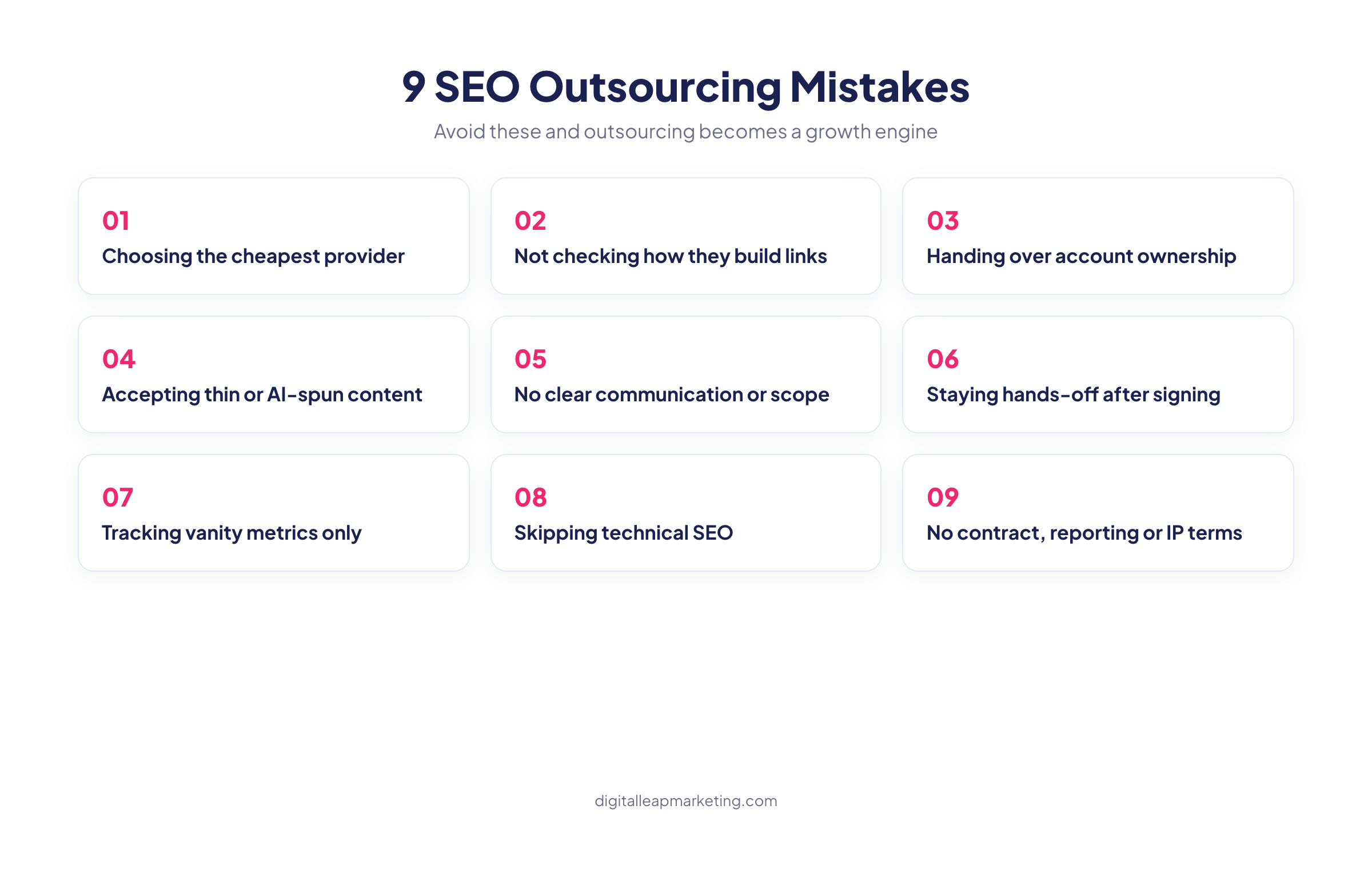
This guide walks through the nine SEO outsourcing mistakes that do the most damage, why each one hurts, and exactly how to avoid it. Whether you are hiring a freelancer, a local agency, or an offshore partner, avoiding these traps is the difference between SEO that compounds and SEO that becomes a cleanup project.
Key Takeaways
- The biggest risk in outsourcing SEO is choosing on price alone. Cheap SEO usually means spammy links and thin content that trigger penalties.
- Always keep ownership of your Google Search Console, Google Analytics, website, and content. Never hand over full control.
- Vet how a provider builds links before you sign. Manipulative link schemes violate Google’s spam policies and can sink your site.
- Set a clear scope, reporting cadence, and success metrics in writing. Rankings alone are a vanity metric; track traffic, leads, and revenue.
- Offshore SEO is not inherently risky. Capability, transparency, and communication matter far more than location.
- Expect four to six months before meaningful results. Anyone promising instant rankings is a red flag.
Is Outsourcing SEO Actually Risky?
Outsourcing SEO is not risky by default. Millions of businesses outsource search work every year and grow because of it. The risk comes from a bad match: a provider who cuts corners, communicates poorly, or is never held accountable to real business outcomes. In other words, the danger is in the execution, not the decision.
It helps to separate two questions. First, should you outsource? That depends on your time, in-house expertise, and budget. If you want to weigh it properly, compare the tradeoffs in our breakdown of in-house SEO vs. outsourcing. Second, and more important for this article: how do you outsource without getting burned? That is where the following nine mistakes come in. Get these right and outsourcing becomes one of the highest-leverage growth channels you have.
9 SEO Outsourcing Mistakes to Avoid
1. Choosing the Cheapest Provider Instead of the Most Capable
The single most expensive mistake in SEO is buying on price. A $99-per-month package cannot fund the strategy, quality content, and legitimate link building that real SEO requires, so something has to give, and it is usually your long-term rankings.
Cheap providers make their margins by automating spam: mass-produced content, low-quality directory links, and recycled strategies applied to every client. It looks like activity, but it rarely moves the metrics that matter, and it often creates liabilities you pay to undo later. Legitimate SEO is labor-intensive. When the price looks too good to be true, the corners are being cut somewhere you cannot see.
The fix: Evaluate providers on capability, not just cost. Ask for case studies, sample deliverables, and references. Understand what is actually included at each price tier. A fair benchmark helps: wholesale or white-label SEO typically runs $300 to $900 per month for local scope and $900 to $2,500 for mid-market work. If someone is charging a fraction of that, ask exactly what you are getting. For more context on how pricing works behind the scenes, see our guide to what white-label SEO is.
2. Not Verifying How They Build Links
Before you sign anything, ask exactly how a provider earns links, because manipulative link building is the fastest way to get your site penalized. Bargain SEO vendors frequently rely on private blog networks (PBNs), paid link placements, and automated link spam, all of which violate Google’s link-spam policies.
Links are still a core ranking signal, which is exactly why so many cheap providers fake them. The problem is that a toxic backlink profile does not just fail to help; it can actively harm you, forcing costly disavow work and recovery. Google’s guidance is explicit that links intended to manipulate rankings are against its spam policies, and enforcement has only gotten sharper.
The fix: Require transparency on link sources. A trustworthy partner earns links through genuine outreach, digital PR, and quality content, and will happily explain their process and show you sample placements on real sites with real traffic. Understand the difference between a followed and a nofollow link, and be wary of anyone promising a fixed number of links per month with no context. Ethical, editorially earned link building is slower but durable.
3. Handing Over Control Without Keeping Ownership
Never let a provider create or hold your core accounts in their own name. You should own your Google Search Console, Google Analytics, website, domain, and all content outright, with the provider granted access, not the other way around.
This mistake is invisible until the relationship ends. Businesses regularly discover, too late, that their agency owned the Analytics property, the CMS login, or even the domain registration, and that leaving means losing years of data, published content, and rankings overnight. Some providers use this lock-in as a retention tactic. Others are simply careless. Either way, you lose leverage and continuity.
The fix: Set up and own every critical asset yourself, then add the provider as a user or manager. Confirm in writing that all content, links, and data belong to you and transfer to you if you part ways. Ownership of your accounts, historical data, and published work should be non-negotiable from day one.
4. Accepting Thin or Spun Content
Content is where cheap outsourcing shows up first. Mass-produced, keyword-stuffed, or lightly reworded AI content may fill a calendar, but it fails Google’s helpful-content expectations and rarely earns rankings or trust.
Google’s guidance rewards content created for people, demonstrating real expertise and originality, and its systems are designed to demote content produced primarily to game search rankings. Thin content also damages your brand: prospects who land on generic, error-filled pages bounce. Volume without substance is a liability, not an asset, and scaled low-quality content is specifically called out in Google’s spam policies.
The fix: Insist on a content sample before committing, and judge it as a reader, not a keyword checker. Ask who writes and edits, how subject-matter accuracy is verified, and how the provider handles your brand voice. Good content should be genuinely useful, original, and tied to search intent. If AI tools are used, they should assist skilled humans, not replace them.
5. Skipping a Clear Scope, Cadence, and Expectations
Most outsourcing relationships fail because of ambiguity, not incompetence. Without a defined scope of work, communication rhythm, and shared definition of success, both sides drift into frustration and blame.
When expectations are vague, you assume one thing is included and the provider assumes another. Deadlines slip, deliverables are disputed, and the “we thought you were handling that” conversations pile up. This is entirely preventable with a small amount of upfront structure.
The fix: Define the scope in writing before work begins: which services, how many deliverables, what timeline, and what counts as success. Agree on a communication cadence, whether that is a weekly update and a monthly review call, and name a single point of contact on each side. Clarity at the start prevents nearly every dispute later.
6. Going Completely Hands-Off After Signing
Outsourcing SEO does not mean abdicating it. The clients who see the best results stay lightly involved: they provide business context, approve strategy, and review progress, rather than disappearing once the contract is signed.
No external partner understands your customers, margins, and priorities as well as you do. When you go silent, the provider fills the gaps with assumptions, and work can drift away from what actually drives revenue. A total hands-off approach also means problems fester unnoticed for months. Partnership beats handoff every time.
The fix: Treat your provider as an extension of your team. Share your business goals, your best-converting products or services, and feedback from sales and support. Review reports, ask questions, and approve major strategic shifts. A few hours a month of engagement dramatically improves outcomes.
7. Measuring Success by Vanity Metrics or Rankings Alone
A number-one ranking that drives no traffic, leads, or revenue is not success. Judging SEO by rankings alone, or by inflated vanity metrics, hides whether the work is actually helping your business.
Rankings fluctuate, personalize, and vary by location, so a single keyword position tells you little. Some providers lean on this, reporting improvements on obscure, low-value terms while the metrics that pay the bills stay flat. Impressions and “keywords tracked” can look impressive while conversions go nowhere. What matters is qualified organic traffic and what it does once it arrives.
The fix: Tie reporting to business outcomes: organic traffic, conversions, leads, pipeline, and revenue, alongside supporting signals like keyword visibility and domain authority trends. Agree on which metrics define success before work starts, and expect reports that connect SEO activity to results, not just a wall of rankings.
8. Overlooking Technical SEO
Content and links cannot compensate for a broken foundation. If your site is slow, hard to crawl, or poorly structured, even great work underperforms, yet technical SEO is the piece budget providers quietly skip.
Technical issues, crawl errors, broken redirects, duplicate content, weak site architecture, and poor Core Web Vitals, silently cap your potential. They are also less visible than a shiny new blog post, so they get deprioritized. The result is a site fighting itself, where every new page has to overcome structural drag.
The fix: Make sure your scope explicitly includes a technical audit and ongoing technical maintenance, not just content and links. Ask how the provider handles site speed, crawlability, indexing, and structured data such as schema markup. If technical work is missing, you have found a gap. Our technical SEO services page outlines what a healthy foundation should cover.
9. Signing With No Contract, Reporting, or IP Terms
A handshake and a monthly invoice are not a working agreement. Without a written contract covering scope, reporting, ownership, and exit terms, you have no protection when something goes wrong, and eventually something will.
This mistake compounds all the others. No contract means no agreed scope, no defined reporting cadence, no clarity on who owns the content and links, and no clean way to leave. Businesses in this situation often feel trapped, unsure whether they even own the work they paid for. That uncertainty is entirely avoidable.
The fix: Put everything in writing: services and deliverables, reporting frequency, pricing, contract length, cancellation terms, and explicit intellectual-property ownership confirming that all content, data, and links belong to you. A provider confident in their work will welcome this, not resist it.
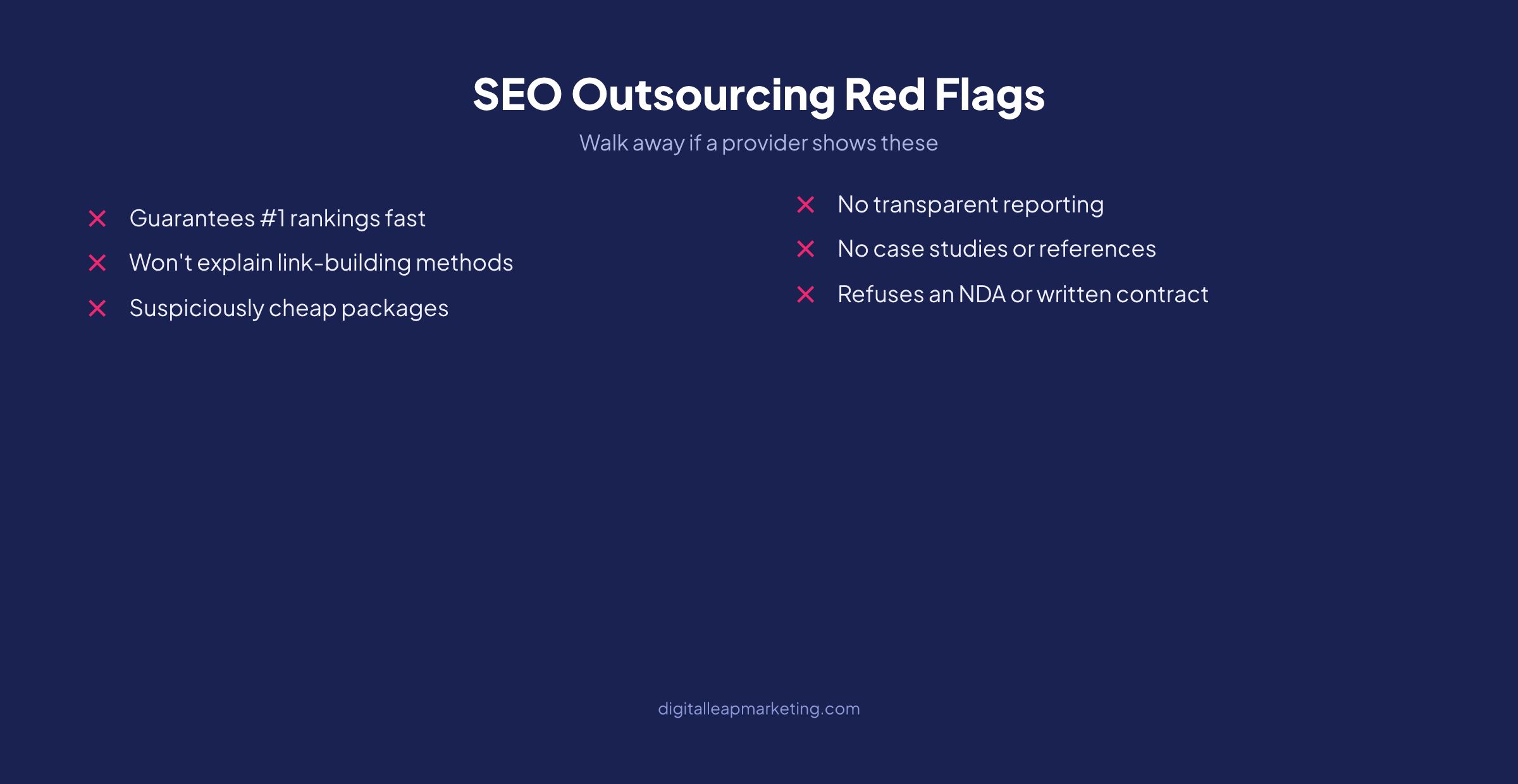
SEO Outsourcing Red Flags Checklist
Use this checklist when vetting any SEO provider. If several of these apply, walk away.
- Guarantees a #1 ranking or promises results in days or a couple of weeks.
- Pricing is dramatically below market with no explanation of what is included.
- Cannot or will not explain how they build links.
- Wants to create your Google Search Console, Analytics, or domain accounts in their own name.
- Refuses to share samples, case studies, or references.
- Reports only rankings, never traffic, leads, or revenue.
- Uses vague deliverables like “SEO work” with no defined scope.
- Pushes a long contract with no clear cancellation terms.
- Will not put content and link ownership in writing.
- Communicates rarely, slowly, or only when you chase them.
Offshore and India SEO: Real Risk or Outdated Myth?
One of the most persistent myths in this space is that outsourcing SEO offshore, and to India in particular, is inherently risky. The truth is that location is a poor predictor of quality. Capability, transparency, and communication matter far more than a time zone.
The reputation comes from a real problem, but a misdiagnosed one. The market is flooded with ultra-cheap providers, some offshore, some not, who sell spam at scale. What burns businesses is the $99 package and the black-hat shortcuts behind it, not the country on the invoice. There are excellent SEO teams in India and poor ones in the United States, and vice versa. Judging on geography instead of capability is just a faster way to make Mistake #1.
In practice, a strong offshore partner can be an advantage. Time-zone differences can mean work progresses overnight, and the cost efficiency lets you fund more strategy and content per dollar, provided the quality is real. The evaluation criteria do not change: transparent link building, genuine content, account ownership, business-outcome reporting, and a clear contract. Apply the same standards you would to any provider. If you are weighing regions, our comparison of outsourcing SEO to India vs. the Philippines breaks down the tradeoffs, and our guide on how to outsource SEO to India covers vetting step by step.
How to Outsource SEO the Right Way
Avoiding the mistakes above is most of the battle. Here is the positive version, a simple process for outsourcing SEO that works.
- Define your goals first. Know what success looks like in business terms, more qualified traffic, leads, or revenue, before you talk to providers.
- Vet on capability. Review case studies, sample deliverables, and references. Confirm how they build links and create content.
- Secure ownership. Own your accounts, domain, data, and content, and get IP terms in writing.
- Agree on scope and metrics. Put the services, timeline, reporting cadence, and success metrics into a written contract.
- Stay involved. Share business context, review reports, and treat the provider as an extension of your team.
- Give it time. Expect four to six months for meaningful results, and judge progress on trend, not a single ranking.
For a deeper look at why outsourcing works when it is done this way, see our rundown of the reasons to outsource your SEO, and if you run an agency, our white-label SEO services for agencies explain how the same principles apply to reselling.
Frequently Asked Questions
What are the most common SEO mistakes?
The most common SEO mistakes when outsourcing are choosing a provider on price alone, allowing manipulative link building, losing ownership of your accounts and content, accepting thin or spun content, skipping technical SEO, and measuring success by rankings instead of traffic and revenue. Nearly all of them trace back to inadequate vetting and a vague or missing contract.
What are the common outsourcing mistakes?
Beyond SEO specifics, the common outsourcing mistakes are unclear scope and expectations, poor communication, going fully hands-off after signing, no defined success metrics, and no written agreement covering ownership and exit terms. These issues cause most failed outsourcing relationships regardless of the service being outsourced.
What is the 80/20 rule in SEO?
The 80/20 rule in SEO is the idea that roughly 80% of your results come from about 20% of your efforts. In practice, a focused set of activities, strong technical foundations, high-quality content targeting the right intent, and legitimate links, drives the majority of gains. When outsourcing, make sure your provider prioritizes these high-impact fundamentals rather than spreading effort thin across low-value tasks.
Why is SEO no longer relevant?
SEO is still highly relevant; the way it works has evolved. Search now includes AI overviews and richer results, which changes tactics but not the fundamentals: helpful, original content, a sound technical foundation, and genuine authority still win. What has become obsolete is manipulative, low-quality SEO, which is exactly why choosing a capable, transparent provider matters more than ever.
Is outsourcing SEO worth it?
Yes, outsourcing SEO is worth it when done correctly. It gives you access to specialized expertise and tools without the cost of building an in-house team, and it lets you scale faster. The value depends entirely on choosing a capable, transparent partner and avoiding the mistakes in this guide. Done well, outsourced SEO is one of the highest-ROI marketing investments available.
Outsource SEO Without the Regret
Every mistake on this list is avoidable with the right partner, one who earns links the honest way, creates content worth reading, hands you full ownership, reports on real business outcomes, and puts it all in writing. At Digital Leap, we built our process around exactly these principles so US businesses can outsource with confidence, not caution. If you want a transparent, capability-first team, explore our SEO outsourcing services and see how outsourcing is supposed to feel.