
White label SEO is when one agency provides SEO services under another agency’s brand. A third-party provider does the actual work — audits, content, link building, reporting — and hands it back unbranded, so the client-facing agency delivers it as its own. It lets agencies offer SEO without hiring an in-house team.
If you run a web design shop, a PPC agency, or a small marketing firm, you have almost certainly had a client ask, “Can you handle our SEO too?” Saying no sends revenue out the door. Saying yes — then scrambling to hire specialists, buy tools, and manage deliverables — is how agencies burn out. White label SEO is the third option: partner with a provider who does the work quietly in the background while you keep the client relationship and the brand.
This guide is written for agency owners who are weighing that decision. We will cover what white label SEO actually is, exactly how the workflow runs and who does what, what it costs (with real markup math), how to vet a partner without getting burned, and the honest trade-offs of working with an offshore team. No hype — just the mechanics you need to decide if it fits your agency.
What Is White Label SEO?
White label SEO (sometimes called private label SEO) is a business arrangement where an SEO provider fulfills work on behalf of another agency, and that agency resells the work under its own name. The end client never sees the provider. To them, everything — the strategy, the monthly report, the rankings — comes from the agency they hired.
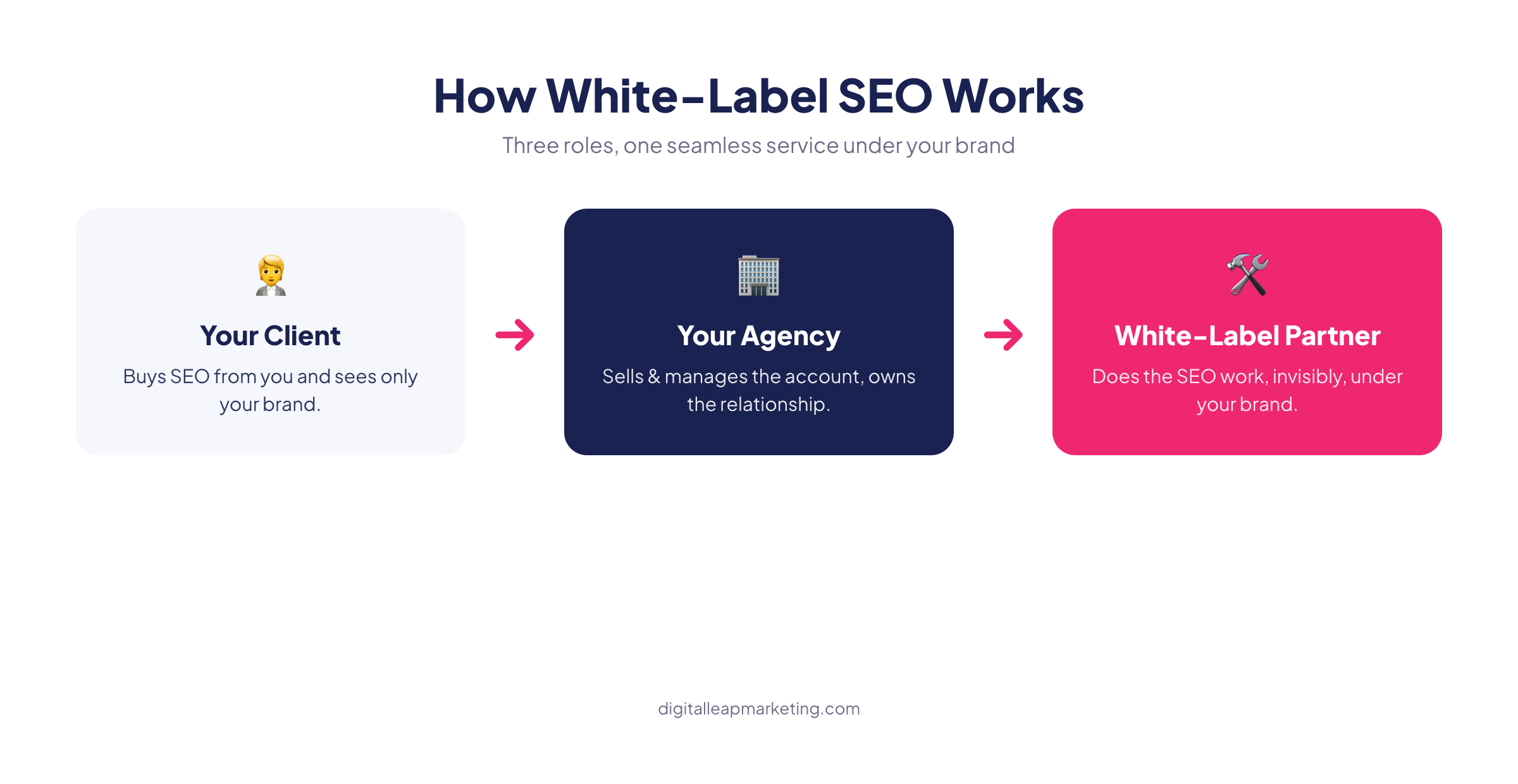
Here is a concrete example. A five-person digital agency lands a local dental group that wants to rank for “invisalign near me” across six locations. The agency is great at web design and paid ads but has no SEO team. Instead of turning the project away, they hand the SEO scope to a white label partner. The partner runs the keyword research, optimizes the pages, builds the links, and produces a branded report with the agency’s logo on it. The agency reviews it, adds their own commentary, and presents it to the dentist as their own work. The dentist pays the agency; the agency pays the partner a wholesale rate and keeps the margin.
That is the whole model: you own the client and the brand, the partner owns the execution.
White Label SEO vs. SEO Reseller vs. Outsourcing: What’s the Difference?
These three terms get used interchangeably, but they describe slightly different things, and the distinction matters when you are choosing a partner.
- White label SEO emphasizes the branding: the deliverables are unbranded (or carry your brand) so you can resell them as your own. The defining feature is that the provider stays invisible.
- SEO reseller emphasizes the commercial relationship: you buy SEO at a wholesale rate and resell it at retail. Many “reseller programs” come with a partner dashboard, tiered pricing, and sales support. Reselling is usually white label by default.
- SEO outsourcing is the broadest term — simply having an external team do the work. Outsourcing is not always white label; a freelancer you hire might not care whether their name reaches the client. White label is a specific, brand-protective type of outsourcing.
In practice, for an agency the three overlap heavily. If you want to learn the mechanics of handing work to an external team more broadly, our guide on how to outsource SEO to India covers the operational side, and the in-house SEO vs. outsourcing comparison weighs the build-vs-buy decision.
How Does White Label SEO Work?
The confusing part for most agency owners is not the concept — it is the choreography. Who talks to whom? Whose logo goes where? Here is how a healthy white label relationship is actually structured.
Who Does What: The Roles Breakdown
| Task | The End Client | Your Agency (the reseller) | White Label Provider |
|---|---|---|---|
| Signs the contract & pays retail | Yes | — | — |
| Owns the client relationship | — | Yes | — |
| Sets scope & approves strategy | Approves | Yes | Recommends |
| Keyword research & audit | — | Reviews | Does |
| On-page & technical work | — | Reviews | Does |
| Content & link building | — | Reviews | Does |
| Monthly reporting | Receives (your brand) | Presents | Produces (unbranded) |
| Pays wholesale rate | — | Yes | Receives |
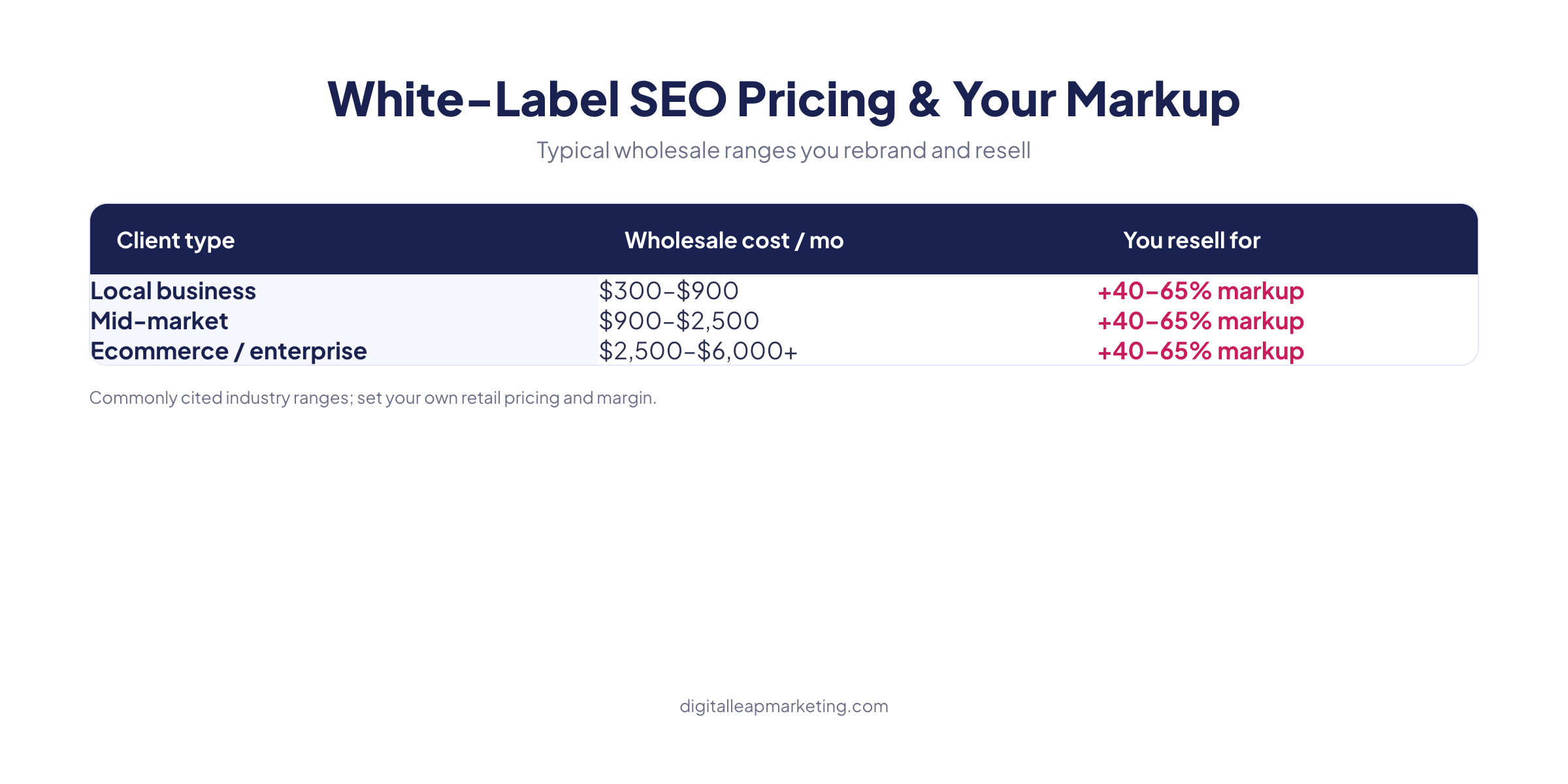
The golden rule: the provider almost never speaks to the end client directly. You are the single point of contact. Some partners will join client calls as “a member of your team” if you want extra firepower on technical questions, but the default is that they stay backstage.
A Typical Monthly Workflow
- Onboarding & brief. You send the partner the client’s site, goals, target locations, and any brand guidelines. A good partner runs a technical audit and a keyword research pass before proposing a plan.
- Strategy sign-off. The partner returns a roadmap; you review it, adjust anything that doesn’t fit the client, and approve.
- Execution. The partner handles on-page SEO, technical fixes, content, and off-page SEO such as link building throughout the month.
- Reporting. You receive an unbranded or your-branded report. You add commentary and forward it to the client. (See our note on white label SEO reports for agencies.)
- Review & iterate. You relay client feedback; the partner adjusts next month’s priorities.
What’s Included in White Label SEO Services?
Scope varies by partner, but a full-service white label engagement typically covers the same disciplines you would build in-house:
- Technical SEO audits — crawlability, site speed, indexation, and schema markup implementation.
- Keyword research & strategy — mapping search demand to the client’s pages and priorities.
- On-page optimization — titles, meta descriptions, headings, internal linking, content structure.
- Content production — blog posts, landing pages, and supporting content written to rank.
- Link building — earning quality backlinks through outreach and digital PR. Many agencies buy this as a standalone service; see our link building services.
- Local SEO — Google Business Profile optimization, citations, and location pages for multi-location clients.
- Reporting & dashboards — branded monthly reports and, in many programs, a white label client dashboard.
You can buy the whole stack or à la carte. Agencies that already do their own on-page work, for instance, often white label only link building or content, where the labor and cost pressure is highest.
Who Uses White Label SEO?
White label SEO is most common among agencies that have client demand but not the internal capacity to meet it:
- Web design and development studios whose clients ask “will this site actually rank?” after launch.
- PPC and social media agencies that want to add organic search to their retainer and capture more of each client’s budget.
- Full-service marketing firms that need to scale delivery faster than they can hire.
- Freelancers and small consultancies who want to take on bigger accounts without becoming a full agency.
The common thread is a skill or capacity gap. If you have the clients and the trust but not the SEO bench, white label fills the gap without payroll.
Benefits of White Label SEO for Agencies
- Add a service line without hiring. A senior SEO, a content writer, and a link builder are three salaries plus tools. A white label partner is one predictable invoice.
- Scale up and down with demand. Add clients without adding headcount; pause when a client churns without laying anyone off.
- Protect (and grow) margin. You buy wholesale and sell retail — more on the math below.
- Move faster. An established partner has processes, tools, and specialists ready on day one instead of a three-month ramp.
- Stay focused. You keep doing what you are best at — the client relationship, creative, or paid media — while execution runs in the background.
For a fuller treatment of the economics, our breakdown of the benefits of outsourcing SEO goes deeper on the cost and risk side.
How Much Does White Label SEO Cost? (Real Ranges + Markup Math)
Most guides dodge this question. Here are honest industry-standard ranges as of 2026. Treat them as ballparks — actual pricing depends on scope, market, and provider quality, and you should always confirm with a quote.
| Service | Typical wholesale range (what you pay) | Common retail range (what you charge) |
|---|---|---|
| Full-service SEO retainer (SMB) | $300–$1,000 / mo | $750–$2,500 / mo |
| Full-service SEO retainer (competitive niche) | $1,000–$3,000 / mo | $2,500–$7,500 / mo |
| Local SEO package | $200–$600 / mo | $500–$1,500 / mo |
| Content (per 1,000-word article) | $40–$120 | $120–$350 |
| Link building (per quality link) | $75–$300 | $150–$600 |
| One-time technical audit | $150–$500 | $500–$1,500 |
How the Markup Works
The reseller model runs on the spread between wholesale and retail. A common target is a 2x to 3x markup, which leaves room for your account management, sales, and profit after the partner is paid.
Worked example: you pay a partner $600/month to fulfill a client’s SEO. You charge the client $1,800/month. After the $600 wholesale cost, you keep $1,200 in gross margin for essentially managing the relationship and reviewing deliverables. Land five clients on that structure and you are adding $6,000/month in gross margin without a single new hire. That leverage is the entire reason the model exists.
A word of caution: don’t price purely on markup. Price on the value and results the client receives, and make sure your retail rate is competitive in your market. Wholesale cost sets your floor, not your ceiling.
Is White Label SEO Legal and Ethical?
Yes. White labeling is a completely legal and standard business practice across nearly every industry — grocery store brands, contract manufacturing, and agency subcontracting all work the same way. Reselling a service under your own brand is not deceptive or against any search engine’s rules, and Google does not penalize sites for using an outside SEO team.
The ethics live in two places. First, honesty with your client: you are not obligated to disclose your subcontractor, but you should never claim capabilities or results you can’t stand behind. Second, the tactics your partner uses. White-hat SEO — earning links and rankings through quality — keeps everyone safe. If a partner leans on spammy link schemes or thin auto-generated content, your client’s site is the one that eats the Google penalty, and your agency’s name is on it. That is why vetting matters, which brings us to the next section.
How to Choose a White Label SEO Partner (7-Point Checklist)
Your partner’s quality becomes your reputation. Vet them the way your best client would vet you:
- Verifiable reviews and references. Look beyond their own testimonials — search third-party reviews and, ideally, talk to a current agency partner.
- Real case studies. Ask for results in niches similar to your clients’, with the metrics that matter (traffic, rankings, leads), not vanity numbers.
- Transparent, published pricing. Clear wholesale rates and packages signal a mature operation. Vague “contact us for everything” pricing is a friction point.
- White-hat, documented processes. Ask exactly how they build links and produce content. You want a straight answer, not evasion.
- Genuinely white label reporting. Confirm reports and dashboards can carry your brand — and that no provider branding leaks to the client.
- Communication and turnaround. Test their responsiveness before you sign. Slow replies during sales get slower after.
- A partner you can actually work with. Overlapping working hours, a dedicated account contact, and a clear escalation path.
Red Flags to Avoid
- Guarantees of “#1 rankings” or specific positions — nobody can promise that honestly.
- Prices far below the ranges above; someone is cutting corners, usually on links or content quality.
- Refusal to explain their link-building sources or content process.
- Bulk, low-quality backlinks or private blog network (PBN) links pitched as a bargain.
- No client-review process — they push deliverables straight to your clients without your sign-off.
- Poor English in client-facing reports, or unwillingness to match your brand voice.
The Offshore Advantage: Why Agencies Partner with India-Based Providers
A large share of white label SEO is fulfilled by teams in India, and there are practical reasons agencies in the US, UK, and Australia choose that route rather than hiring locally.
- Cost structure. Lower operating costs mean the wholesale rates in the table above are achievable while still funding experienced specialists — which is what makes a healthy 2x–3x markup possible.
- Deep talent pool. India has one of the largest concentrations of SEO, content, and technical specialists in the world, so scaling a team up quickly is realistic.
- Time-zone coverage. The offset can be a feature, not a bug: work briefed at the end of your day is often progressing overnight, and a good partner overlaps a few hours with your working day for calls.
- Maturity of the model. Offshore SEO delivery is well established, so processes, tools, and quality controls are already built.
The honest trade-off is that quality varies widely, so the vetting checklist above matters more, not less. Look for clear communication, native-quality client-facing writing, and overlapping working hours. When those boxes are checked, the cost and scale advantages are hard to beat. Our overview of running an SEO outsourcing company in India explains how established teams manage exactly these quality and communication concerns.
How to Start Reselling SEO (Step by Step)
- Pick your scope. Decide whether you’ll resell full-service SEO or start with one service (link building or content are common entry points).
- Choose a partner using the checklist above. Start with one and run a pilot before you commit multiple clients.
- Set your pricing. Use the wholesale ranges as your floor and price retail on value and your local market — aim for a 2x–3x spread.
- Package it. Turn the partner’s services into your own tiered packages with your branding, so it slots into your existing sales conversations.
- Run a pilot client. Prove the workflow and reporting on one account before scaling.
- Systematize. Standardize onboarding, review, and reporting so each new client adds margin, not chaos.
Frequently Asked Questions
How much does white label SEO cost?
Wholesale white label SEO typically runs from about $300 to $3,000 per month for a full-service retainer, depending on the client’s competitiveness, with à la carte content and links priced per piece. Agencies usually resell at a 2x–3x markup, so a client paying $1,800/month might sit on a $600 wholesale cost. Always confirm exact pricing with a quote, since scope drives the number.
Is white labeling legal?
Yes. White labeling is a legal and widespread business practice — reselling another company’s service under your own brand is standard across most industries, and it does not violate any search engine guidelines. The only real risk is if a partner uses spammy or manipulative tactics, which is why you should confirm they follow white-hat SEO practices before signing.
What are the 4 types of SEO?
SEO is usually grouped into four types: on-page SEO (optimizing content and page elements), off-page SEO (building authority through backlinks and mentions), technical SEO (crawlability, speed, indexation, and schema), and local SEO (ranking in a specific geographic area via Google Business Profile and citations). A full-service white label partner should handle all four.
Is SEO dead in 2026?
No — but it is evolving. AI Overviews and AI-driven search have changed how results appear, which shifts tactics toward strong content, brand authority, and technical health. Search demand and the value of ranking remain high, and businesses still need help capturing it. For agencies, that ongoing change is exactly why a specialist white label partner is useful: staying current is their full-time job.
Ready to Add SEO to Your Agency?
If your clients keep asking for SEO and you’d rather deliver it than turn it away, white label is the fastest path. Digital Leap is an India-based team that fulfills SEO under your brand — audits, content, links, and your-branded reporting — so you keep the client and the margin. Explore our white label SEO services for agencies, or book a no-pressure reseller consultation to map out what a partnership could look like for your accounts.