For medical practices wondering how long it takes for medical SEO to work, early movement can often appear within 3 to 6 months, while more consistent, measurable results may take around 6 to 12 months. These results can include more calls, form submissions, and appointment requests. The exact timeline depends on your website’s age, specialty, location, competition, existing content, and technical setup.
SEO success is not just about rankings. A practice can climb the search results and still see little change in patient volume if the traffic does not convert. Real progress can move from visibility to traffic, leads, and appointments, with each stage taking time to develop.
| Timeframe | Main Activities | Expected Signals | Possible Business Outcomes |
|---|---|---|---|
| Months 1 to 3 | Technical fixes, indexing, local SEO setup | Search impressions, small ranking movement | Limited, mostly foundational |
| Months 3 to 6 | Content expansion, service pages, long tail targeting | More ranking keywords, growing organic traffic | Early leads and calls |
| Months 6 to 12 | Authority building, content refinement | Stronger service page rankings, qualified traffic | Consistent calls and appointment requests |
| 12 months and beyond | Ongoing optimization, competitive keyword targeting | Broader visibility, higher authority | Sustained traffic and lead growth |
Medical SEO Timeline: What to Expect
SEO progress happens in stages rather than all at once. Search engines need time to discover changes, process updated pages, and reassess how those pages perform in search. The ranges below are a planning guide, not a guarantee, since every practice starts from a different position.
Months 1 to 3: Building the Foundation
This stage focuses on fixing technical problems that block search engines from properly crawling and indexing the site, cleaning up site structure, and getting the Google Business Profile and local listings in order.
You may see search impressions begin to rise and small ranking movement on lower competition terms, but this stage is largely groundwork rather than a traffic surge.
Months 3 to 6: Growing Search Visibility
As new and improved service pages get indexed, practices typically start ranking for a wider set of long-tail terms, such as specific procedures or symptoms rather than broad specialty names.
Organic traffic may begin to grow during this window, and some practices may start seeing their first organic leads, although volume can remain modest.
Months 6 to 12: Building Consistent Results
By this point, service pages that were optimized early often hold stronger positions, and traffic becomes more qualified because visitors are searching with clearer intent.
At this stage, some practices may begin to see a more consistent flow of calls and inquiries, giving them more data to evaluate SEO performance.
12 Months and Beyond
Past the first year, an established medical SEO program tends to compete more effectively for higher difficulty keywords and broader specialty terms. Authority built over the previous months compounds, supporting continued traffic and lead growth without the same intensity of foundational work required at the start.
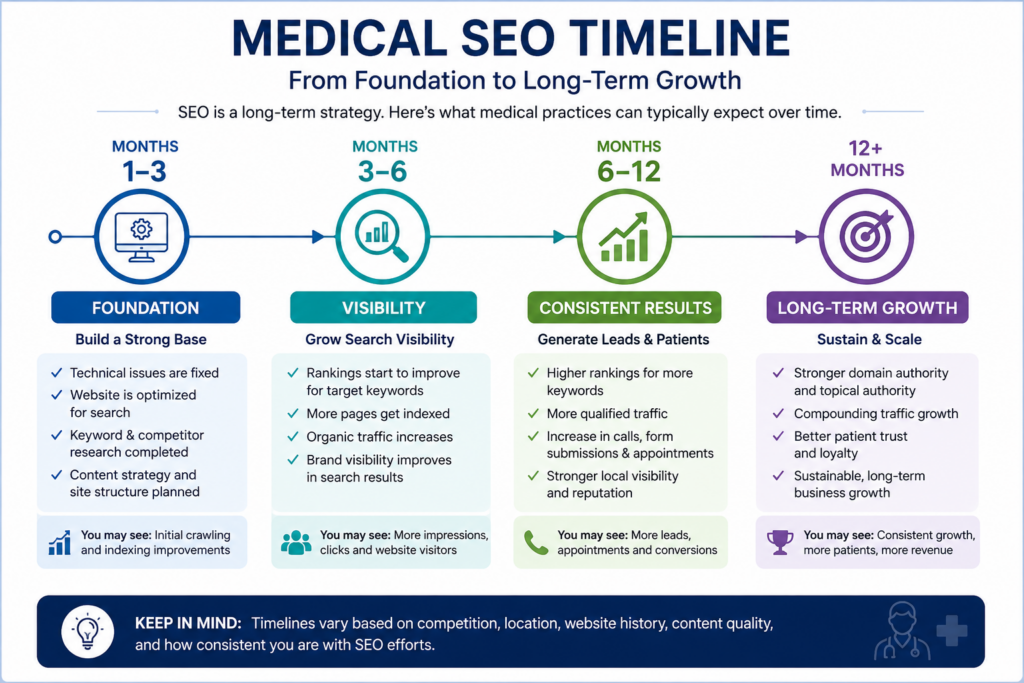
Medical SEO timeline showing the journey from building a strong foundation to achieving long-term search visibility and growth.
Why Does Medical SEO Take Time?
Healthcare SEO tends to move more slowly than SEO in less regulated industries because search engines apply extra scrutiny to content that can affect a person’s health or financial decisions.
Competition, site history, content depth, and demonstrated trust all shape how quickly a given practice moves, which is why identical efforts on two different websites can produce different timelines.
Healthcare Content Needs Strong Trust Signals
Search engines weigh E-E-A-T, meaning experience, expertise, authoritativeness, and trustworthiness, heavily for medical content. Pages written or reviewed by qualified providers, with clear author information, cited references, and regularly updated content, tend to earn trust faster than generic pages with no visible expertise behind them.
Competition Varies by Specialty and Location
A dermatology practice in a major metro area competing against dermatology groups and med spa SEO campaigns will face a different timeline than a primary care office in a smaller town with less search demand and fewer competitors.
Search volume, the number of established competitors, and how aggressively they invest in SEO all factor into how long it takes to gain visibility.
How Long Does SEO Take for Different Medical Specialties?
Specialty and search intent influence the timeline, though no specialty has a fixed number of months. What varies is the level of competition and how specific the searches tend to be.
Dental SEO
Dental SEO often involves strong local competition, since most patients search within a narrow radius of home or work. General dentistry terms tend to be more competitive than specific cosmetic or restorative service searches, so practices often see faster movement on procedure-specific pages before broader terms.
Dermatology SEO
Dermatology combines high-volume local searches with a mix of medical and cosmetic service demand. Cosmetic treatment keywords are often more competitive because they attract both dermatology practices and med spas, while medical dermatology searches, such as those related to skin conditions, can present more accessible opportunities early on.
Orthopedic and Surgical SEO
Procedure-specific searches, such as those related to joint replacement or sports injury treatment, often compete against well-established hospital systems and multi-location practice groups with significant existing authority. This can extend the timeline for ranking on the most competitive procedure terms, even when technical SEO and content quality are strong.
Primary Care SEO
Primary care relies heavily on local intent, including near me searches and location-specific terms. Because these searches are tied closely to convenience and proximity, local SEO signals such as Google Business Profile optimization often influence visibility as much as, or more than, broader content strategy.
What Factors Affect Your Medical SEO Timeline?
Every practice starts from a different position, which is why two websites doing similar work can see different results at different speeds.
Website Age and Existing Authority
A domain with years of history, existing indexed content, and some organic traffic already established generally has a head start compared to a brand new website with no track record for search engines to evaluate.
Content Quality and Expertise
Service pages, treatment pages, and provider pages that clearly demonstrate expertise tend to perform better than thin or generic pages. Content built around real patient questions, backed by accurate information, supports both rankings and E-E-A-T at the same time.
Keyword Competition
Search demand, keyword difficulty, and the strength of competitors already ranking all affect how long it takes to move up. A low competition, highly specific term can rank in weeks, while a broad, high demand term in a competitive market may take considerably longer.
Technical SEO Health
Crawlability, indexability, clean site structure, sensible internal linking, and mobile usability form the base that everything else depends on. Unresolved technical issues can slow or completely stall progress, regardless of how strong the content is.
Local SEO and Reputation
An optimized Google Business Profile, consistent citations, and a steady stream of genuine patient reviews all support local visibility, which matters enormously for practices depending on nearby patients.
Backlinks and External Authority
Relevant backlinks from healthcare publications, professional organizations, and legitimate digital PR placements build authority over time. No specific number of backlinks guarantees faster rankings, and link building should focus on relevance and credibility rather than volume.
New Medical Practice vs Established Practice
Where a practice starts has a real effect on how quickly SEO can move.
New Practice With a New Website
A new practice typically has limited website history, little established authority, and few or no existing rankings to build from. More of the early months go toward foundational work, including technical setup, local SEO, and building out core service pages from scratch.
Established Practice With Existing Visibility
A practice with an existing website often has some rankings, indexed content, and accumulated authority already in place. Work here tends to focus on identifying optimization opportunities within existing pages, which can sometimes produce visible movement faster than starting from zero.
A Practice Switching SEO Agencies
Practices moving from a previous provider need a review of past work before moving forward. That typically means checking for unresolved technical issues, evaluating the quality and relevance of existing backlinks, identifying content gaps, and preserving whatever useful authority the site has already built rather than starting the whole strategy over.
What Does It Mean When Medical SEO Is Working?
Rankings alone are an incomplete signal. Meaningful medical SEO results follow a progression: visibility leads to rankings, rankings lead to impressions, impressions lead to traffic, and traffic eventually leads to leads and appointments.
Early Signs of SEO Progress
In the earlier months, look for growing search impressions, movement on tracked keywords, more pages getting indexed, and improved visibility in local search results.
Signs of Meaningful SEO Results
Later on, the signals shift toward organic traffic growth, visitors who match your target patient profile, and actual engagement such as calls, form submissions, and appointment requests.
Measuring SEO ROI
The clearest measure of return is tracking leads, new patients attributable to organic search, conversion rate from visitor to inquiry, and the value of each new patient relative to what was spent to acquire them.
What Can Delay Medical SEO Results?
Some delays are avoidable, and identifying them early prevents months of wasted effort.
Technical and Content Issues
Crawl errors, indexing problems, thin or duplicate content, and confusing site structure can all slow or block progress, since search engines struggle to properly evaluate pages with these issues.
High Competition
Competitive specialties, dense metro markets, and highly contested keywords naturally extend timelines, since outranking well-established competitors takes more sustained effort than lower competition situations.
Weak Authority
Limited backlinks, few credible industry mentions, and a thin online reputation make it harder to earn search engine trust, which can slow rankings even when on-page content is strong.
How to Improve Medical SEO Results
No legitimate strategy can guarantee faster rankings, but removing avoidable delays can help an SEO program progress more efficiently.
Fix Technical Problems
Resolving crawlability, indexability, site architecture, and mobile experience issues creates a stronger technical foundation for other SEO efforts.
Improve High-Value Pages
Strengthening service pages, treatment pages, and provider pages, along with relevant internal links and clear alignment with search intent, can improve the quality and relevance of the pages that matter most.
Target Realistic Keywords
Prioritizing long-tail keywords, local searches, and specific service terms can help practices build search visibility while more competitive keywords continue to develop over time.
Build Relevant Authority
Earning relevant healthcare backlinks, industry mentions, and credible editorial coverage can strengthen a medical website’s authority and support its ability to compete for more competitive searches.
When Should You Reconsider Your Medical SEO Strategy?
Slow progress does not automatically mean medical SEO has failed. Before changing strategy, look at rankings, traffic, conversions, technical issues, content quality, and search intent together.
Rankings Are Not Improving
If rankings remain flat for an extended period, review your technical SEO, content quality, search intent, internal linking, and competitor strength. These checks can help identify what may be limiting progress.
Traffic Is Growing, but Leads Are Not
If organic traffic increases but leads do not, check whether the keywords match patient intent. Also review your service pages, conversion paths, calls to action, and lead tracking.
Rankings Improved, but Business Results Did Not
Higher rankings do not always produce more patients. If rankings improve without business results, check whether the ranking keywords attract qualified visitors and whether those visitors have a clear path to contact or book an appointment.
Final Takeaway
Medical SEO commonly takes three to six months to show early movement and six to twelve months to build consistent, measurable results, though the exact medical SEO timeline depends on your website’s starting point, specialty, location, competition, content quality, technical SEO, local SEO, and authority.
SEO is a gradual process rather than a fixed deadline. Progress follows a clear path: visibility leads to traffic, traffic leads to leads, and leads lead to patients.
Practices that stay focused on the fundamentals and that measure the right signals at each stage put themselves in the strongest position for results that hold up over time.