AI Search Optimization for Healthcare is the practice of improving a healthcare website and its content so AI-powered search experiences can understand, evaluate, and potentially reference the brand when answering health-related questions. These experiences include Google AI Overviews, Google AI Mode, ChatGPT Search, and Perplexity.
The goal is not to manipulate an AI system. Instead, healthcare brands should provide clear, accurate, well-supported information that helps search systems understand their expertise and relevance.
AI search optimization also builds on traditional SEO rather than replacing it. AI search optimization also builds on traditional SEO rather than replacing it. Healthcare brands can strengthen this foundation with a focused healthcare SEO strategy that addresses technical performance, content, and search visibility. Strong technical SEO, useful content, clear site architecture, and credible information remain important foundations.
What Is AI Search Optimization for Healthcare?
Traditional SEO focuses heavily on helping pages appear in search results and encouraging users to click through to a website. AI search changes the experience by giving users synthesized answers that may draw information from several sources.
For example, instead of scanning several pages for information about migraine treatment, a user might ask an AI search tool, “What are the most common treatment options for chronic migraines?” The system can then provide an answer and, depending on the platform and query, link to supporting sources.
As a result, healthcare brands need to think beyond rankings. They also need content that clearly answers questions, demonstrates expertise, and gives search systems useful information to reference.
| Factor | Traditional SEO | AI Search Optimization |
|---|---|---|
| Search behavior | Keyword-based queries | Conversational, question-based queries |
| User intent | Click through to a page | Get a direct answer, sometimes without clicking |
| Results format | Ranked list of links | Generated summary with optional citations |
| Visibility opportunity | Position in search results | Selection as a cited or referenced source |
| Content approach | Keyword-targeted pages | Direct answers plus depth and evidence |
| Measurement | Rankings, clicks, sessions | Mentions, citation share, referral traffic |
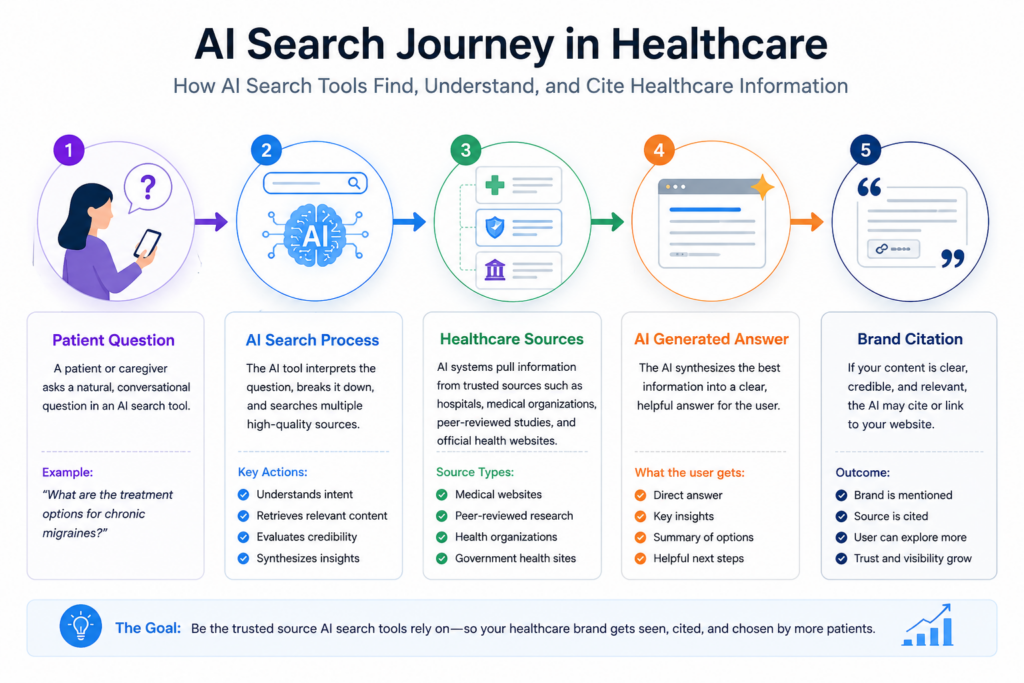
The AI Search Journey From Patient Question to Healthcare Brand Citation
How Patients Are Using AI to Find Healthcare Information
Patients can use AI search tools to ask complete questions instead of entering short keywords. This makes thorough keyword research useful for identifying the questions, topics, and search intent healthcare content should address.
For example, someone researching sleep apnea might ask, “What are the treatment options for sleep apnea if I cannot tolerate CPAP?”
Similarly, a patient looking for a specialist might ask:
- “How do I choose a cardiologist if heart disease runs in my family?”
- “Which type of specialist treats chronic migraines?”
- “What should I know before choosing a knee replacement surgeon?”
- “What questions should I ask a dermatologist about acne treatment?”
These searches reveal more than a single keyword. They show the user’s topic, concern, intent, and sometimes their stage in the decision-making process.
Therefore, healthcare content should address the questions patients and healthcare professionals actually ask, rather than relying only on short keyword phrases.
Why AI Search Matters for Healthcare Brands
Patients often research healthcare providers, conditions, treatments, and procedures before contacting an organization. They may compare providers, review treatment options, look for risks, or research questions they plan to ask during an appointment.
As AI search becomes another way to gather this information, healthcare brands have another opportunity to become visible during that research process. A brand may receive value from being mentioned or cited even when the user does not immediately visit the website.
The potential journey looks like this:
AI visibility → Brand recognition → Website visit → Inquiry → Appointment
However, visibility alone does not guarantee a patient conversion. The website still needs to provide accurate information, a strong user experience, and a clear next step.
Why Healthcare Requires Stronger Trust Signals
Healthcare content can influence decisions about symptoms, treatments, providers, and medical care. Therefore, accuracy and credibility matter greatly.
Healthcare brands can demonstrate credibility through:
- Qualified authors and healthcare professionals
- Medical reviewers where appropriate
- Clear author credentials
- Reliable references and sources
- Accurate medical information
- Clearly stated review or update dates
- Transparent editorial processes
- Relevant clinical expertise
Healthcare content should also avoid unsupported medical claims. When a page discusses clinical information, credible sources should support important claims wherever appropriate.
What Makes Healthcare Content More Likely to Appear in AI Search?
Useful healthcare content generally needs to satisfy several requirements at once. It should address a relevant question, provide enough depth, demonstrate credible expertise, and remain technically accessible to search systems.
For example, a strong page about cataract surgery should not simply repeat a definition. Instead, it can explain what the procedure involves, who may need it, what patients can expect, common questions, recovery considerations, and where readers can find authoritative medical information.
At the same time, the page should remain focused on the user’s needs instead of adding information simply to increase word count.
Create Direct, Evidence-Based Answers
Question-based headings can help organize healthcare content around specific user needs.
For example:
What Is the Recovery Time After Cataract Surgery?
The section should answer the question directly before providing additional context. Then, it can explain factors that may affect recovery and direct readers to reliable medical sources for further information.
This structure benefits readers because they can find the answer quickly. It also creates clearly defined sections that search systems can understand more easily.
However, direct answers should not replace depth. Complex healthcare questions often require context, qualifications, evidence, and explanations.
Demonstrate Healthcare Expertise
Healthcare content should clearly communicate who created and reviewed it.
Depending on the topic, useful trust signals can include:
- Author credentials
- Medical reviewer information
- Provider qualifications
- Relevant clinical experience
- References and sources
- Publication dates
- Last reviewed or updated dates
For example, a page explaining a complex medical treatment should identify the author and, where appropriate, the qualified professional who reviewed the content.
This approach gives readers more context about the expertise behind the information and creates a more transparent content experience.
How to Optimize a Healthcare Website for AI Search
Traditional technical SEO remains the foundation of AI search optimization. A healthcare website needs to be crawlable, indexable, and easy for search engines to understand. This is where technical SEO services can help improve the website’s technical foundation and search visibility.
Google states that pages need to meet the normal technical requirements for Search to be eligible as supporting links in AI Overviews or AI Mode. There are also no additional technical requirements or special AI-only schema requirements for those Google AI features.
Therefore, healthcare brands should continue to focus on:
- Crawlability
- Indexability
- Internal linking
- Clear page structure
- Mobile usability
- Helpful textual content
- Appropriate structured data
- Strong page experience
Technical optimization cannot replace useful content. Instead, it helps ensure that search systems can access and understand the content a healthcare brand has created.
Build Topic Clusters Around Patient Questions
Healthcare websites can strengthen topical coverage by connecting related questions and resources. Strong on-page SEO can also help organize these pages around relevant topics, headings, content, and internal links.
For example, a topic cluster around sleep apnea could include:
- What is sleep apnea?
- Sleep apnea symptoms
- Types of sleep apnea
- Sleep apnea diagnosis
- Sleep apnea treatment options
- CPAP therapy
- Alternatives to CPAP
- Sleep apnea recovery and management
- Questions to ask a sleep specialist
Internal links should connect these pages naturally.
For instance, a symptoms page can link to a diagnosis resource, while a treatment page can connect to information about specific treatment options.
This structure helps users move through related information while giving search engines clearer context about the relationships between pages.
Use Structured Data and Clear Website Architecture
Structured data can help search engines understand entities and page content when the markup accurately represents the visible information.
Healthcare websites should use appropriate structured data based on the actual content and entity represented on the page. Depending on the website, this may include organization, medical organization, physician, article, or other relevant schema types.
However, structured data does not guarantee AI citations or AI search visibility.
The most important principle is consistency. The information in structured data should match what users can actually see on the page.
Build E-E-A-T and Brand Authority for AI Search
Healthcare brands need to demonstrate expertise across the website rather than relying on a single author bio or one well-written article.
A strong healthcare website can reinforce credibility through:
- Detailed provider profiles
- Professional qualifications
- Author bios
- Medical review processes
- Reliable references
- Original research where available
- Expert contributions
- Relevant third-party mentions
Furthermore, brand authority should extend beyond the website.
Strengthen Your Healthcare Brand Beyond Your Website
Third-party recognition can support a healthcare brand’s overall authority.
Relevant opportunities can include:
- Respected healthcare publications
- Professional organizations
- Industry associations
- Expert interviews
- Healthcare podcasts
- Original research
- Digital PR
- Relevant editorial backlinks
- Genuine industry mentions
Quality matters more than simply collecting a large number of links or mentions.
For example, a relevant mention from a respected healthcare publication can provide more meaningful context than dozens of unrelated directory links.
Therefore, healthcare brands should prioritize relevant, credible sources when developing external authority.
Optimize for Patient and Healthcare Professional Search Intent
Patients and healthcare professionals often need different types of information, even when they research the same condition.
Patients may want simple explanations and practical information. In contrast, healthcare professionals may need clinical evidence, research, guidelines, and outcome data.
For this reason, healthcare brands should consider separate content pathways when the audience and intent differ significantly.
Patient-Focused Content
Patient-focused content can address:
- Symptoms
- Treatment options
- Procedures
- Risks and considerations
- Recovery
- Cost and insurance questions
- Preparing for appointments
- Choosing a provider
The language should remain clear and accessible. Avoid unnecessary medical terminology, and explain clinical terms when they are important to the topic.
HCP-Focused Content
Healthcare professional content can address:
- Clinical research
- Evidence
- Guidelines
- Treatment protocols
- Clinical outcomes
- Emerging developments
- Technical healthcare topics
This content can use professional terminology, but it should still provide clear sourcing and identify the expertise behind the information.
Common AI Search Optimization Mistakes Healthcare Brands Should Avoid
Healthcare brands should avoid several common mistakes when developing an AI search strategy.
- Publishing unreviewed AI-generated medical content: AI-generated drafts can contain inaccurate or unsupported information. Human review becomes especially important for medical topics.
- Keyword stuffing: Repeating keywords can make content unnatural without making it more useful.
- Publishing thin content: Short pages that provide little original value may struggle to compete with more useful resources.
- Making unsupported medical claims: Important healthcare claims should have appropriate evidence or authoritative support.
- Using fake or exaggerated author credentials: Healthcare expertise should be genuine and verifiable.
- Leaving information outdated: Medical information can change, so important content should receive appropriate reviews and updates.
- Creating duplicate pages: Multiple pages with substantially similar information can make the site’s content architecture less clear.
- Ignoring technical SEO: Search systems need to access and understand the page before the content can compete for visibility.
- Creating unnecessary “AI schema”: There is no special schema that guarantees AI citations. Focus on appropriate structured data and strong SEO fundamentals.
- Using artificial reviews or fabricated mentions: Reputation should come from genuine patient experiences and legitimate third-party recognition.
How to Measure AI Search Optimization for Healthcare
Traditional rankings provide useful information, but they do not show the complete picture of AI search visibility.
For example, a healthcare brand can monitor whether it appears when users ask important questions across relevant AI search platforms. It can also compare those results with competitors.
Useful KPIs include:
| KPI | What It Shows |
| AI mentions | How often the brand appears in relevant AI answers |
| AI citations | How often the website is linked or referenced as a source |
| Citation share | The brand’s citation presence compared with competitors |
| Brand visibility | Overall presence across relevant AI search experiences |
| Organic impressions | How often pages appear in traditional search |
| Organic traffic | Visits generated through organic search |
| Referral traffic | Visits generated from external and AI platforms |
| Leads | Inquiries generated through search visibility |
| Appointment requests | Patient actions that can be attributed to search |
In addition, healthcare brands should compare these metrics with their competitors for the same topics.
For Google AI features specifically, Google reports traffic from AI Overviews and AI Mode within the overall Web search data in Search Console rather than as a separate search type. Therefore, brands should combine Search Console data with analytics and conversion data when evaluating performance.
Final Takeaway
AI Search Optimization for Healthcare is not a replacement for traditional SEO. Instead, it extends the same foundation into a search environment where users may receive synthesized answers rather than a simple list of links.
Healthcare brands that want stronger AI search visibility should focus on accurate and useful content, clear expertise signals, technically accessible websites, well-organized topic coverage, credible external authority, and content that answers real patient and healthcare professional questions.
Most importantly, there is no single tactic that guarantees an AI citation. However, a healthcare brand can improve its chances by becoming a source that search systems can clearly understand and that readers can confidently trust.
Frequently Asked Questions
What is AI Search Optimization for Healthcare?
AI Search Optimization for Healthcare helps healthcare websites become easier for AI search systems to understand, evaluate, and potentially cite. It combines traditional SEO with clear content, strong expertise signals, trustworthy sources, and accessible website architecture.
How can healthcare brands appear in AI search results?
Healthcare brands can improve AI visibility by creating accurate, well-sourced content, demonstrating healthcare expertise, maintaining strong technical SEO, and building credible third-party authority.
Does traditional SEO still matter for AI search?
Yes. Traditional SEO remains the foundation. Crawlability, indexability, useful content, internal linking, mobile usability, and structured data help search systems access and understand healthcare websites.
How can healthcare content become more likely to be cited by AI?
Create clear, accurate content that directly answers specific healthcare questions. Support important claims with credible sources and demonstrate genuine expertise through qualified authors, reviewers, and transparent references.
Does structured data help with AI search?
Structured data helps search engines understand the entities and information on a page. However, it does not guarantee AI visibility or citations, and there is no special AI schema that guarantees inclusion.
How do you measure AI search visibility?
Track AI mentions, citations, citation share, and brand visibility alongside organic impressions, traffic, referrals, leads, and appointment requests. This shows both AI visibility and its potential business impact.