

Someone in your city is searching for a therapist right now. They will scroll through the first few results, check a Google Business Profile, read a handful of reviews, and pick one of the practices they see on the screen. If your practice is not one of them, that person becomes someone else’s client, not because your care is worse, but because your practice is harder to find.
Local SEO for therapists is the work that puts your practice in front of that person at the exact moment they are looking. It is not a one-time project. It is an ongoing set of habits around your Google Business Profile, your website, your reviews, and your content that together tell Google and AI search tools that your practice is real, local, and trustworthy.
- Local SEO helps therapy practices appear in Google’s Local Pack, Google Maps, and AI-powered answer engines when nearby clients search for care.
- Google Business Profile optimization, consistent citations, and patient reviews are the three highest-impact ranking factors for therapists.
- Local SEO for physical therapists carries different intent signals than mental health searches, largely driven by referrals, insurance, and injury urgency.
- Schema markup, FAQ sections, and direct answer formatting increase the odds that AI tools like ChatGPT, Google AI Overviews, Gemini, and Perplexity surface your practice.
- Success should be tracked through rankings, Google Business Profile insights, website traffic, and actual phone calls or booked appointments, not rankings alone.
What Is Local SEO for Therapists?
Local SEO for therapists is the practice of optimizing your online presence so your practice appears in local search results, map listings, and AI-generated answers when someone nearby searches for therapy or counseling services.
Unlike general SEO, which focuses on ranking nationally, local SEO strategies for therapists are built around proximity, trust, and intent. A person searching for a therapist almost always wants someone within driving distance or a reasonable telehealth radius, someone who takes their insurance, and someone other clients have vouched for.
Local SEO for a therapist typically includes:
- Optimizing and maintaining a Google Business Profile
- Using location-specific keywords across the website
- Building accurate, consistent citations across directories
- Collecting and responding to patient reviews
- Publishing content relevant to the practice’s city or region
- Adding structured data (schema markup) so search engines and AI tools understand what the practice offers and where
According to CDC survey data, 58.5 percent of U.S. adults searched online for health information in the second half of 2022, and that share continues to grow. For therapists, that means the discovery process for a huge share of new clients now starts with a search engine, not a referral.
Why Local SEO Matters for Therapy Practices
Local SEO helps therapists appear in front of nearby clients who are actively searching for mental health services. It improves visibility in Google Maps, local search results, and AI-powered search experiences. Local SEO matters for therapists because most people choose a provider based on what they can find and verify online before they ever pick up the phone. Therapy is a high-trust decision. Prospective clients are not just comparing services; they are evaluating whether a provider feels safe, credible, and accessible.
A solid local SEO strategy for therapists delivers several concrete outcomes:
- Higher visibility for searches like “therapist near me” or “counselor in [city].”
- More qualified calls and form submissions from people already looking for care in your area
- Stronger competitive position against larger group practices and directories like Psychology Today
- Increased patient trust through visible reviews, accurate information, and a professional web presence
- A lower cost per new client compared to paid advertising over time
According to rater8’s 2025 patient survey, online reviews are one of the strongest influences on which healthcare provider a patient ultimately chooses, which is one more reason review management belongs inside your local SEO strategy rather than as a separate task.
Local SEO Strategies for Therapists That Actually Work
The most effective local SEO strategies for therapists combine an optimized Google Business Profile, consistent local citations, genuine patient reviews, and content written for the specific communities a practice serves. Each piece reinforces the others. A profile with no reviews looks incomplete. A website with strong content but inconsistent citations confuses search engines about where the practice is actually located.
The most important local SEO strategies for therapists include:
- Google Business Profile optimization
- Local keyword targeting
- Citation building
- Review management
- Local content creation
Claim and Optimize Your Google Business Profile
Your Google Business Profile is usually the first thing a prospective client sees, often before they ever visit your website.
- Claim and fully verify your profile if you have not already
- List accurate hours, phone number, address, and accepted insurance where applicable.
- Choose specific, relevant categories such as “mental health service” or “counselor”
- Upload real photos of your office, not stock images.
- Post updates regularly, including new services or availability
- Respond to every review, positive or negative, in a professional tone.
A complete, active profile significantly improves your odds of appearing in the Local Pack, the top three map results shown for local searches.
Target the Right Local Search Terms
Keyword research for therapists should reflect how real clients actually search, not just industry terminology.
- “Therapist in [city]”
- “Anxiety counseling near me”
- “Marriage counselor [neighborhood]”
- “Local seo for therapist” style searches from practice owners researching marketing, if you also publish for other providers
Place these terms naturally in page titles, headings, service pages, and blog content. Avoid repeating the same phrase mechanically. Search engines and AI tools now reward natural language far more than exact match repetition.
Build Consistent Local Citations
A citation is any online listing of your practice’s name, address, and phone number, commonly referred to as NAP.
- List your practice on Psychology Today, Healthgrades, Yelp, and general local directories.
- Keep NAP details identical across every listing, down to formatting.
- Correct old or duplicate listings, which are common when a practice has moved or changed phone providers
- Treat citation accuracy as ongoing maintenance, not a one-time setup task.
Inconsistent NAP data is one of the most common reasons a well-built website still underperforms in local rankings.
Earn and Manage Patient Reviews the Right Way
Reviews influence both rankings and a prospective client’s final decision, but therapists must handle them carefully given confidentiality expectations.
- Ask satisfied clients if they are comfortable leaving a general, non-identifying review.
- Never solicit reviews that reference diagnosis, treatment details, or session content.
- Respond to reviews without confirming or denying that someone is a client, consistent with HIPAA guidance.
- Address negative reviews calmly, without disclosing any protected information.
This balance protects both your compliance obligations and your reputation.
Publish Locally Relevant Content
Content built around your actual community signals relevance to both search engines and AI answer tools.
- Write about topics tied to your city, such as stress management resources specific to your area.
- Reference local partnerships, community involvement, or events where appropriate.
- Keep content genuinely useful first, and locally flavored second.
Add Local Business Schema Markup
Structured data helps search engines and AI systems understand your practice with precision rather than guesswork.
- LocalBusiness or MedicalBusiness schema for your core practice details
- FAQPage schema for your frequently asked questions section
- Review schema, used accurately and only for reviews you have genuinely collected.
Schema does not guarantee rankings, but it materially increases the odds of appearing in rich results and of being cited correctly by AI Overviews, ChatGPT, and Perplexity.
Local SEO for Physical Therapists: What’s Different
Local SEO for physical therapists shares the same foundation as therapy marketing, but the search intent behind it looks different. Physical therapy searches are often tied to a specific injury, a recent surgery, or a physician referral, which means urgency and insurance clarity matter more than they typically do for mental health searches.
Practical differences to account for:
- Local seo for physical therapist searches often includes injury or condition terms, such as “physical therapist for knee pain [city].”
- Referral relationships with orthopedic and primary care providers should be reflected in content and backlinks where possible.
- Insurance and direct access laws (patients being able to see a PT without a referral in many states) are worth addressing directly on service pages, since it is a common point of confusion.
- Local seo for physical therapists benefits heavily from location pages when a clinic operates multiple sites, since each location has its own service radius and competitive set.
The core tactics- Google Business Profile optimization, citations, reviews, and schema- apply the same way. The keyword targeting and content angle are what should shift.
Local SEO vs Traditional SEO for Therapists
| Factor | Local SEO | Traditional SEO |
| Primary goal | Rank for searches near a specific city or neighborhood | Rank for broad, often national search terms |
| Key ranking signals | Google Business Profile, citations, reviews, proximity | Backlinks, domain authority, broad content depth |
| Typical search intent | “Near me” or city-specific queries | Informational or research-focused queries |
| Best fit for | Solo practices and clinics serving a defined service area | Multi-state telehealth or national health brands |
| Content focus | City and neighborhood specific pages and posts | Broad topical authority across many related subjects |
Most individual and small group therapy practices should prioritize local SEO first, then layer broader content strategy on top once the local foundation is solid.
How to Measure Local SEO Success for Therapists
The clearest sign your local SEO is working is a measurable increase in calls, form submissions, and booked appointments that can be traced back to search, not rankings in isolation. Rankings are a leading indicator. Booked clients are the outcome that actually matters.
Track these every month:
- Keyword rankings for your core local terms using Google Search Console or a rank tracking tool
- Google Business Profile insights, including profile views, calls, and direction requests
- Website traffic from your target city or region using Google Analytics location filters
- Form submissions and call volume tied to organic or map traffic
- Review count and average rating trend over time
If calls and bookings are trending up alongside these metrics, your local SEO strategy is doing its job.
Common Local SEO Mistakes Therapists Should Avoid
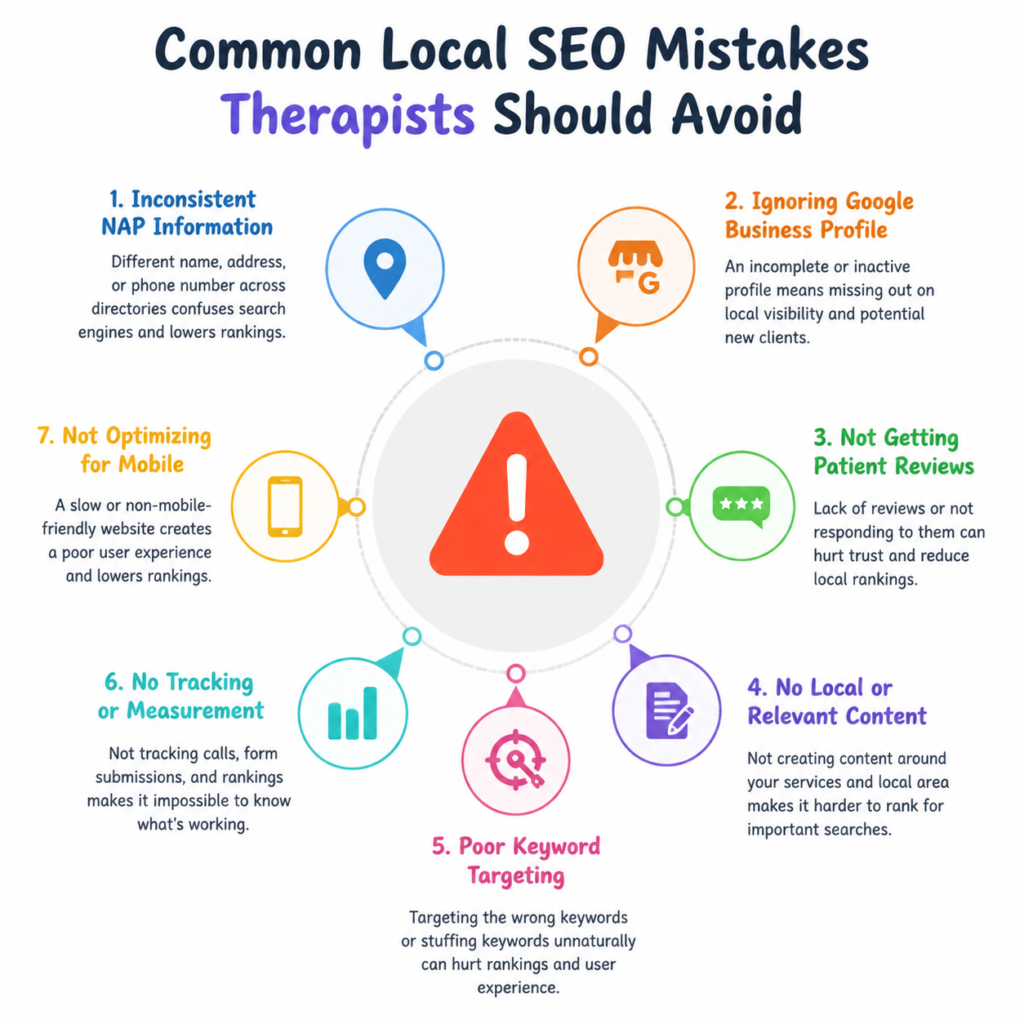
- Leaving the Google Business Profile unclaimed or incomplete
- Letting NAP information drift out of sync across directories
- Writing review requests or responses that reference confidential client details
- Stuffing city names into content unnaturally instead of writing for the reader first
- Never reviewing performance data, which makes it impossible to know what to fix
Why Practices Choose Digital Leap Marketing for Local SEO
Digital Leap Marketing builds local SEO strategies specifically for healthcare providers, which means we already understand the compliance considerations, patient trust factors, and search behavior unique to your field.
Our broader healthcare seo work spans practices from dental offices needing dedicated dental seo services to OBGYN, chiropractic, and med spa clinics, so the strategy we build for your therapy practice is informed by patterns we see across the entire healthcare vertical, not a generic small business playbook.
Here’s why therapists trust Digital Leap Marketing:
- Google Business Profile audit and optimization
- Healthcare citation cleanup and management
- HIPAA-conscious review strategy
- Local content optimization for your service area
- Transparent reporting focused on calls and bookings
The Bottom Line
Local SEO for therapists is not a single fix; it is a set of consistent habits around your Google Business Profile, your citations, your reviews, and your content. Practices that treat it as ongoing maintenance rather than a one-time project are the ones that show up when it matters most, at the moment someone nearby decides they are ready to reach out.
Ready to make your practice easier to find? Talk to Digital Leap Marketing about a local SEO strategy built for your specialty.
Frequently Asked Questions
What is local SEO for therapists?
Local SEO for therapists is optimizing your Google Business Profile, website, and online listings so your practice appears when nearby clients search for therapy services.
How is local SEO for physical therapists different?
Physical therapy searches are often tied to a specific injury or referral, so keyword targeting and content should reflect urgency and insurance clarity more directly.How long does local SEO take to show results?
Local SEO for therapists usually takes 3–6 months to show measurable improvements, while competitive markets may require longer. Results depend on website authority, competition, Google Business Profile optimization, reviews, and content quality.Do I need a website for local SEO to work?
Yes. Your Google Business Profile drives visibility, but a website is what confirms credibility and converts visitors into booked appointments.Can AI search tools like ChatGPT recommend my practice?
Yes, when your practice has consistent citations, clear service descriptions, and structured data, AI tools are more likely to surface it in local recommendations.Related: Prefer it done for you? Explore Digital Leap’s local SEO company for local businesses across the US.