Physical therapy marketing is the combination of digital, local, and relationship based strategies clinics use to attract new patients, retain current ones, and reduce dependence on physician referrals. This guide covers how to build a physical therapy marketing plan, 15 core strategies with implementation steps, how to prioritize by clinic type, and a 90 day roadmap to get started.
What Is Physical Therapy Marketing
Physical therapy marketing is every activity a clinic uses to build awareness, earn trust, and convert prospective patients into scheduled appointments. It sits at the intersection of several disciplines that work together rather than in isolation:
- Digital marketing covers the clinic’s website, search visibility, paid advertising, and content
- Local marketing covers Google Business Profile, local directories, and location specific search presence
- Patient acquisition covers the tactics that generate new patient inquiries, from search to referrals
- Patient retention covers the communication that keeps existing patients engaged through their full plan of care
- Referral marketing covers relationships with physicians, chiropractors, and other healthcare professionals who send patients
- Reputation management covers how the clinic monitors and responds to reviews and patient feedback
Physiotherapy marketing describes the same discipline under different regional terminology. Physiotherapy is the standard professional title in the United Kingdom, Australia, and Canada, while physical therapy is standard in the United States, but the underlying strategies apply equally to both.
Marketing for physical therapy clinics differs from general local business marketing because it carries added weight around clinical trust, patient privacy, and the long decision cycles tied to injury, surgery, and insurance.
Why Physical Therapy Marketing Matters
Physical therapy practices have traditionally relied on physician and chiropractor referrals for a large share of new patients. That referral pipeline remains valuable, but it also carries risk when it is the only source of new patients.
A clinic that depends entirely on a handful of referring physicians can see patient volume drop sharply if even one of those relationships weakens, if a referring physician retires, or if a competing clinic builds a stronger relationship with the same referral sources.
At the same time, more patients now research providers online before ever speaking with a physician, particularly in states and provinces where direct access allows patients to see a physical therapist without a referral.
Patients compare clinics using search results, Google Business Profiles, reviews, and websites in much the same way they compare any other local service.Local competition has also increased as more clinics invest in digital marketing.
A physical therapy marketing plan that builds several independent patient acquisition channels, referral relationships, local search visibility, content, reviews, and paid advertising, gives a clinic more control over its own growth and less exposure to any single source drying up.
How Patients Find a Physical Therapist
Understanding the patient journey helps a clinic decide which marketing asset supports which stage. Most patients move through five stages before booking an appointment, though not always in a straight line.
Problem Awareness
The patient does not yet know physical therapy is a solution. They search things like why does my knee hurt or why does my back hurt after sitting all day. Blog content and educational guides that explain common causes of pain are the right asset for this stage.
Solution Research
The patient starts to understand physical therapy might help. They search can physical therapy help back pain or do I need physical therapy after surgery. Condition specific content and FAQ pages that explain how physical therapy addresses the problem work well here.
Provider Research
The patient is now looking for a specific clinic. They search physical therapist near me or best physical therapy clinic in their city. This is where Google Business Profile, local SEO, and location pages carry the most weight.
Comparison
The patient is weighing a shortlist of clinics. They search physical therapy clinic reviews or physical therapist for sports injuries. Reviews, testimonials, staff credentials, and specialty pages influence this stage.
Conversion
The patient is ready to book. They search book physical therapy appointment or physical therapy in their city with clear booking intent. A fast, low friction scheduling process and a responsive front desk matter most here.
A complete physical therapy marketing plan should have at least one asset supporting each stage, rather than concentrating all effort on the provider research and conversion stages alone.
How to Build a Physical Therapy Marketing Strategy
Before choosing individual tactics, a clinic needs a strategy that defines who it is trying to reach and how it will know if the effort is working.
1. Define Your Target Patient
Most clinics see a mix of patient types, but marketing works better when it prioritizes the groups that best match the clinic’s expertise, services, and business goals rather than trying to speak to everyone equally. Common patient groups include:
- Sports injury patients
- Post surgical patients
- Chronic pain patients
- Older adults
- Pediatric patients
- Pelvic health patients
- Workers compensation patients
- Cash pay patients
A clinic with a strong post surgical rehabilitation program and close relationships with local orthopedic surgeons should prioritize that patient group in its content and referral outreach, rather than spreading marketing budget evenly across every possible patient type it could theoretically treat.
2. Analyze Local Competitors
A useful competitor review looks at what other clinics in the area are doing well and where they fall short, so the clinic can find a real opportunity rather than guessing. Compare:
- Google Business Profile completeness, categories, and review volume
- Review ratings and how competitors respond to feedback
- Services listed and specialties emphasized
- Location pages, if the competitor has multiple sites
- Website content depth and condition specific pages
- Overall website experience, including mobile usability
- How easy it is to book an appointment on their site
- Whether they run visible paid advertising
- General market positioning, such as premium, high volume, or specialty focused
- Backlinks and mentions from local health organizations, where relevant
3. Define the Clinic’s Differentiator
A physical therapy marketing plan works better when every piece of content and every ad points back to a real, specific reason a patient should choose this clinic over another one nearby. Examples of a genuine differentiator include:
- Same week appointment availability
- A dedicated sports rehabilitation program
- One on one care with a licensed therapist for the full session
- Therapists with board certified specialties
- Evening or weekend appointment hours
- A structured post surgical rehabilitation pathway
- A convenient, high visibility location
The differentiator should be something the clinic can actually deliver and stand behind, not a generic claim shared by every competitor in the area.
4. Set Measurable Marketing Goals
A goal like get more traffic does not tell the clinic whether marketing is actually working. A goal like increase qualified new patient inquiries by 20 percent over 90 days gives the team something specific to track and a timeframe to evaluate it against. Every strategy below should tie back to a goal phrased this way rather than a vague intention.
15 Physical Therapy Marketing Strategies
From local SEO and patient education to paid advertising and referrals, these strategies cover the key channels physical therapy clinics can use to increase visibility and attract new patients.
Use the visual guide below for a quick overview of all 15 strategies before exploring each one in detail.
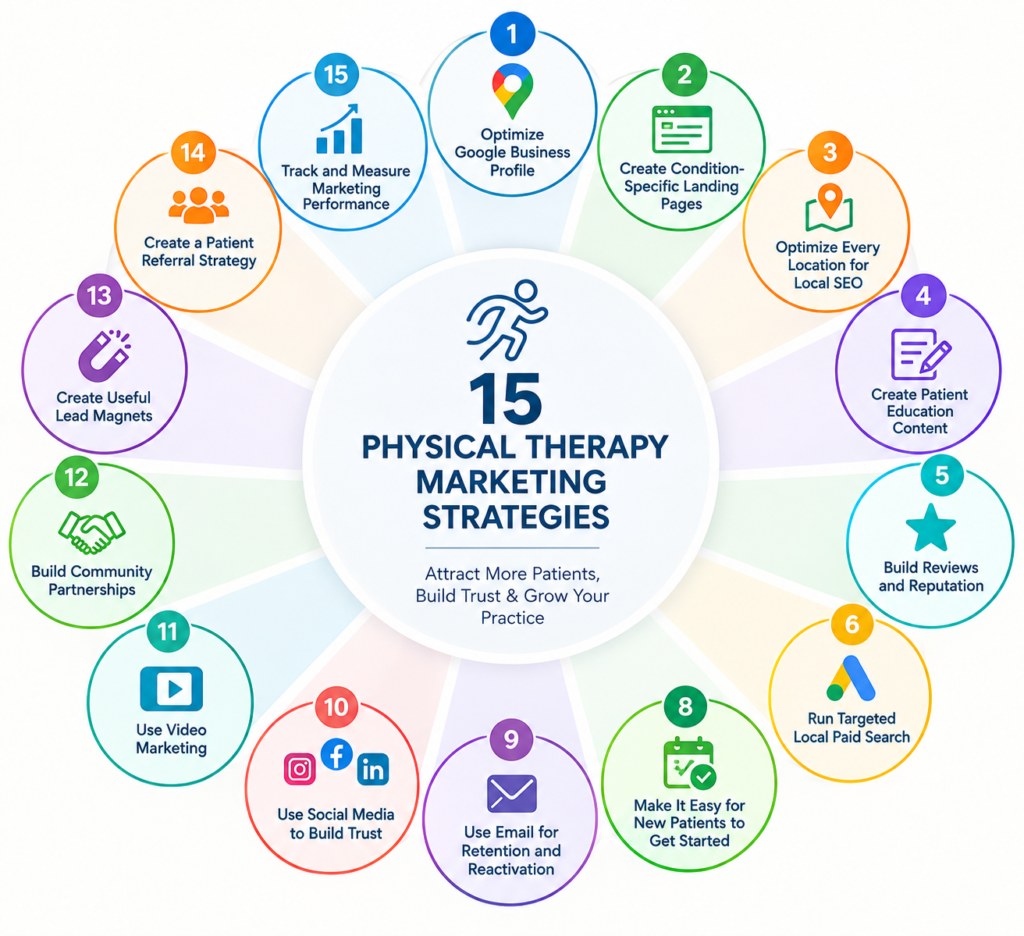
1. Optimize Google Business Profile
What it is. Google Business Profile is the free listing that controls how a clinic appears in Google Maps and local search results, including hours, services, photos, and reviews.
Why it matters. For most patients in the provider research stage, the Google Business Profile is the first real impression of the clinic, often before they ever visit the website.
How to implement it. Claim and verify the listing, select the most accurate primary category along with relevant secondary categories, list every service offered with a short description, upload current photos of the facility and team, post regular updates about new providers or services, and respond to every review professionally.
PT specific examples. A clinic offering both orthopedic and pelvic health services should list both as distinct services with their own descriptions, rather than a single generic physical therapy listing.
What to measure. Track profile views, direction requests, phone calls generated from the profile, and website clicks through Google Business Profile insights.
2. Create Condition Specific Landing Pages
What it is. Dedicated pages that address a single condition or treatment area in depth, rather than one generic services page covering everything.
Why it matters. Patients in the solution research and provider research stages search for their specific condition, not the phrase physical therapy on its own, and a page written directly for that condition matches their intent far better.
How to implement it. Build individual pages such as Physical Therapy for Lower Back Pain, Physical Therapy After ACL Surgery, Sports Injury Rehabilitation, Vestibular Rehabilitation, Physical Therapy for Shoulder Pain, and Physical Therapy for Arthritis. Each page should explain the condition in plain language, describe the clinic’s treatment approach, note what a first visit involves, and include a clear path to request an appointment.
PT specific examples. The ACL surgery page can outline a general recovery timeline and the phases of rehabilitation the clinic follows, without making guarantees about individual patient outcomes.
What to measure. Track organic traffic to each page, appointment requests generated from each page, and rankings for the condition specific search terms each page targets.
3. Optimize Every Clinic Location for Local SEO
What it is. Individual local search optimization for each physical location a multi site practice operates, rather than one generic approach applied across all of them.
Why it matters. A single combined website that does not distinguish between locations makes it harder for any one location to rank well, and it gives patients less relevant information about the specific clinic nearest them.
How to implement it. Build a dedicated page for each location with unique content, including nearby landmarks, parking information, the providers who work at that location, and any services specific to that site. Keep the clinic’s name, address, and phone number accurate and consistent across the website, Google Business Profile, and relevant directories. Add internal links between the main services pages and each location page.
PT specific examples. A clinic with locations near two different hospital systems might emphasize its post surgical relationship with the nearby hospital on each respective location page.
What to measure. Track location page traffic, local map pack visibility for each location, and appointment requests by location.
4. Create Patient Education Content
What it is. Blog posts, guides, and articles that answer the questions patients are actually searching at each stage of their journey.
Why it matters. Content matched to search intent captures patients earlier, before they have chosen a specific clinic, and builds trust by demonstrating clinical expertise.
How to implement it. Map your content to the patient journey by covering common causes of knee pain for problem-aware searches, explaining how physical therapy can help with chronic back pain for solution-aware searches, describing what to expect during a physical therapy evaluation for treatment research, helping patients choose a physical therapy clinic for comparison searches, and highlighting local physical therapy options with a clear booking path for local and transactional searches.
PT specific examples. A guide titled What to Expect at Your First Physical Therapy Appointment After Knee Surgery addresses both solution research and treatment research intent in one piece.
What to measure. Track organic traffic growth by content stage, time on page, and the percentage of blog readers who go on to request an appointment.
5. Build Patient Reviews and Reputation
What it is. An ongoing process for generating honest patient reviews and managing the clinic’s reputation across Google, Healthgrades, and similar platforms.
Why it matters. Reviews influence how patients in the comparison stage evaluate a clinic, and they give prospective patients a sense of what treatment and the overall experience are actually like.
How to implement it. Ask satisfied patients for a review at a natural point in their care, such as after they reach a meaningful milestone or at discharge. Make the request simple, with a direct link to the review platform. Respond to every review professionally, thank patients for positive feedback, and address negative feedback calmly without revealing any protected health information. Avoid selectively asking only patients who had the best outcomes for reviews while skipping others, since this creates a misleading picture and can violate some platform policies.
PT specific examples. A front desk script that asks every discharged patient the same simple question, rather than singling out only the patients staff believe were happiest, keeps the process fair and consistent.
What to measure. Track review volume over time, average rating, and response time to new reviews.
6. Run Targeted Local Paid Search
What it is. Paid search advertising, most commonly Google Ads, targeting patients actively searching for physical therapy related terms in the clinic’s service area.
Why it matters. Paid search can generate patient inquiries immediately, while organic strategies like SEO and content typically take longer to build momentum.
How to implement it. Target condition specific and local intent keywords rather than broad terms like physical therapy alone, which tend to be expensive and attract less qualified traffic. Send ad traffic to a dedicated landing page rather than the homepage, with a clear call to action and simple appointment request path. Set up conversion tracking so the clinic can see which ads actually generate appointment requests, not just clicks. Build a negative keyword list to avoid paying for irrelevant searches.
PT specific examples. A campaign targeting sports injury treatment in the clinic’s city, sending traffic to the sports injury rehabilitation landing page, will typically convert better than a single ad group targeting the broad term physical therapy.
What to measure. Track cost per click, conversion rate from click to appointment request, and cost per new patient acquired through paid search, without assuming these figures will match generic industry averages, since they vary significantly by market.
7. Build Physician and Professional Referral Relationships
What it is. Ongoing relationships with orthopedic surgeons, primary care physicians, chiropractors, sports organizations, and other healthcare professionals who see patients who could benefit from physical therapy.
Why it matters. Referral relationships remain one of the most trusted patient sources, since the referring provider has already vouched for the clinic.
How to implement it. Identify the physicians and organizations whose patient populations align with the clinic’s expertise. Schedule brief introductory meetings, share information about the clinic’s specialties and typical communication practices, and follow up with patient progress updates when appropriate and consistent with patient consent. Make the referral process itself as easy as possible for the referring office.
PT specific examples. A clinic with a strong vestibular rehabilitation program might prioritize outreach to ENT specialists and neurologists, rather than a broad list of every physician in the area.
What to measure. Track new patients by referral source and the consistency of referrals from each relationship over time.
8. Make It Easy for New Patients to Get Started
What it is. Reducing every point of friction between a patient deciding to try the clinic and actually getting on the schedule.
Why it matters. A patient who is ready to book can be lost to a competitor simply because the process was confusing, slow, or required too many steps.
How to implement it. Offer online scheduling alongside phone booking, include a clear click to call button on mobile, explain what insurance the clinic accepts and how billing works, and provide a simple explanation of what to expect at the first visit. Where legally and professionally appropriate for the clinic’s state and payer relationships, a brief consultation or evaluation offer can also help patients who are unsure whether physical therapy is right for them take the first step.
PT specific examples. A short FAQ page answering common first visit questions, such as what to wear and how long the evaluation takes, reduces uncertainty that might otherwise stop a patient from booking.
What to measure. Track the percentage of website visitors who complete an appointment request, and the time between initial inquiry and scheduled appointment.
9. Use Email for Retention and Reactivation
What it is. Email communication used to support patients through their plan of care and to reconnect with patients who have not returned in a while.
Why it matters. Retaining an existing patient and reactivating a past one is generally more efficient than acquiring a new patient from scratch, and email is a low cost way to stay connected with people who have already chosen the clinic once.
How to implement it. Send appointment confirmations and reminders, home exercise resources between visits, and general injury prevention education. Build a reactivation sequence for patients who completed care some months earlier and may benefit from a check in. Always collect clear consent before adding patients to a marketing email list, and keep any clinical information separate from general marketing communication in line with patient privacy requirements.
PT specific examples. A short email six months after discharge asking how a patient’s recovery has held up gives the clinic a natural, non intrusive reason to reconnect.
What to measure. Track email list growth, open and click rates, and appointment requests generated from email campaigns.
10. Use Social Media to Build Trust
What it is. A consistent social media presence focused on education and community connection rather than direct advertising.
Why it matters. Prospective patients often check a clinic’s social media before booking, and provider introductions, educational content, and general exercise demonstrations help them understand the clinic’s expertise before they ever schedule a visit.
How to implement it. Share provider introductions, educational posts explaining common conditions, general exercise demonstration videos, and behind the scenes clinic culture content. Only share individual patient stories with clear, documented consent from the patient, and avoid identifying details that were not explicitly approved for public use.
PT specific examples. A short weekly video series where a different therapist explains one common misconception about their specialty area builds recognition for the whole team, not just the clinic name.
What to measure. Track follower growth, engagement rate, and direct inquiries that mention social media as the referral source.
11. Use Video Marketing
What it is. Short video content used across the website, YouTube, and social channels to explain the clinic, its providers, and general treatment approaches.
Why it matters. Video helps some patients understand what to expect and builds familiarity with providers before a first visit, though it is one channel among several rather than a universal replacement for written content, since different patients prefer different formats.
How to implement it. Create provider introduction videos, general treatment explanation videos, answers to frequently asked questions, and a short video walking through what happens during a typical appointment. Add accurate captions or a transcript to every video, which also gives search engines readable text to index.
PT specific examples. A two minute video explaining what a typical post surgical evaluation looks like helps set expectations for a nervous patient before their first visit.
What to measure. Track video views, watch time, and whether video pages convert to appointment requests at a similar or better rate than text only pages.
12. Build Community Partnerships
What it is. Relationships with local organizations whose members are likely candidates for physical therapy services.
Why it matters. Community visibility builds awareness among people who are not yet actively searching for a clinic, and it creates natural opportunities for direct referrals over time.
How to implement it. Reach out to running clubs, gyms, youth and adult sports organizations, senior living communities, and relevant local organizations. Offer educational sessions, injury prevention talks, or a presence at community events rather than a purely promotional pitch.
PT specific examples. A partnership with a local running club to provide a brief injury prevention talk before race season gives the clinic direct access to a patient population likely to need sports rehabilitation services.
What to measure. Track new patient inquiries that mention a specific community partnership as how they heard about the clinic.
13. Create Useful Lead Magnets
What it is. Free, downloadable resources offered in exchange for a patient’s contact information.
Why it matters. A lead magnet captures patients who are interested but not yet ready to book, giving the clinic a way to stay in touch until they are.
How to implement it. Create resources such as a back pain guide, a running injury prevention guide, a preparing for your first physical therapy appointment guide, or a post surgical recovery checklist. Use a simple, clearly labeled form to collect contact information, explain how the information will be used, and follow up with a short, relevant email sequence rather than an aggressive sales push.
PT specific examples. A downloadable running injury prevention guide shared through a local running club partnership connects strategy 12 and strategy 13 into one coordinated effort.
What to measure. Track downloads, email opt in rate, and the percentage of leads who eventually book an appointment.
14. Create a Patient Referral Strategy
What it is. A structured approach to encouraging satisfied patients to recommend the clinic to friends and family.
Why it matters. Word of mouth from a trusted source carries significant weight, and a small amount of structure around asking for referrals makes it more likely to actually happen.
How to implement it. Focus primarily on making it simple for a satisfied patient to recommend the clinic, such as providing a referral card or a direct link they can share. Healthcare referral incentive programs may be subject to state, federal, and payer specific regulations, including anti-kickback and fee splitting rules in some jurisdictions, so any incentive based referral program should be reviewed by qualified healthcare legal counsel before it launches, rather than modeled directly on a program used by a general consumer business.
PT specific examples. A simple mention during discharge, along with an easy way to share the clinic’s information, is often sufficient without needing a formal incentive structure at all.
What to measure. Track new patients who name a specific patient referral source, and monitor this figure as a share of total new patients over time.
15. Track and Measure Marketing Performance
What it is. A consistent process for reviewing which marketing efforts are actually generating new patients, not just traffic or engagement.
Why it matters. Without measurement, a clinic cannot tell which channels deserve more investment and which are not delivering a return.
How to implement it. Review a defined set of metrics on a monthly basis, organized into four categories.
Acquisition KPIs:
- New patient inquiries
- New patient bookings
- Source of each new patient
- Cost per acquisition by channel
SEO KPIs:
- Organic clicks
- Non branded organic traffic
- Local map pack visibility
- Google Business Profile interactions
- Organic conversions to appointment requests
Website KPIs:
- Appointment requests
- Phone calls generated from the website
- Form submissions
- Overall conversion rate
Retention KPIs:
- Returning patient rate
- Reactivated patients
- Patients acquired through referral
PT specific examples. A clinic that sees strong website traffic but a low appointment request rate likely has a conversion problem on the site itself, not a visibility problem, and should prioritize fixing the booking experience over adding more content.
What to measure. The metrics above are the measurement, and they should be reviewed together rather than in isolation, since traffic alone does not indicate whether marketing is generating actual patients.
Best Strategy by Clinic Type
Not every clinic should implement all 15 strategies with equal priority. The right starting point depends on the clinic’s current situation.
New Physical Therapy Clinic
Prioritize the foundational channels first: a complete Google Business Profile, a functional and mobile friendly website, a small set of condition specific pages for the clinic’s core specialties, and an early physician outreach effort. Content and paid advertising can follow once the foundation is in place.
Established Clinic Heavily Dependent on Referrals
Focus on diversifying patient acquisition rather than replacing referral relationships. Build out local SEO, condition specific content, and a review generation process to create direct patient acquisition channels that do not depend on any single referring physician.
Cash Pay Clinic
Focus on positioning, direct patient acquisition, content that clearly explains the value of the cash pay model, reviews, and strong local visibility, since these clinics typically cannot rely on insurance driven physician referral networks in the same way.
Multi Location Clinic
Focus on location level local SEO, individual Google Business Profiles for each site, consistent reputation management across every location, condition specific content that can be shared across the brand, and reporting that breaks performance down by location rather than only at the brand level.
A 90 Day Physical Therapy Marketing Plan
This roadmap outlines a realistic sequence for implementing the strategies above. It does not promise specific ranking positions or revenue outcomes within 90 days, since results depend heavily on the clinic’s market, competition, and starting point.
Days 1 to 30: Foundation
- Audit and fully complete the Google Business Profile
- Audit the website for conversion friction, particularly on mobile
- Set up analytics and conversion tracking so results can actually be measured
- Complete a local competitor review
- Define the clinic’s target patient groups and differentiator
- Build a consistent review request process
- Audit existing service and condition pages for gaps
31 to 60: Visibility
- Publish new condition specific landing pages for priority patient groups
- Build or refresh location pages for multi site practices
- Publish patient education content mapped to the patient journey
- Begin physician and professional referral outreach
- Produce initial provider introduction and educational videos
- Improve internal linking between content, condition pages, and location pages
Days 61 to 90: Acquisition and Optimization
- Launch local paid search if the budget and goals support it
- Publish the first lead magnet and connect it to an email sequence
- Begin or expand community partnerships
- Test and refine the appointment request process based on real user behavior
- Review the KPI framework from strategy 15 and adjust budget toward what is working
- Set goals for the next 90 day cycle based on what the data shows
How to Know If Physical Therapy Marketing Is Working
Traffic is not the final goal. Qualified patient acquisition and sustainable growth are more important than visitor counts, impressions, or social media followers on their own. A clinic should evaluate marketing performance using the four KPI categories outlined in strategy 15, acquisition, SEO, website, and retention, reviewed together rather than any single metric in isolation. A channel that drives high traffic but few appointment requests is not performing well, even if the traffic numbers look impressive in a report.
Conclusion
Physical therapy marketing works best as a full system, not one tactic. Patients move through stages, from noticing pain to comparing clinics to booking, and your marketing should cover each one: content for early questions, local SEO and Google Business Profile for active searches, reviews for comparison, and easy booking to close the loop.
Start with strategy: know your patient, study competitors, set a clear goal. Then use the 15 strategies here, local SEO, content, reviews, ads, referrals, retention, and measurement, prioritized based on where your clinic stands today. The 90 day plan gives you a realistic order to follow.
Whatever you prioritize, measure real patients, not just traffic. That is what actually grows the practice.
Frequently Asked Questions
What is the most effective marketing strategy for a physical therapy clinic?
No single strategy works best for every clinic. For most clinics starting out, a complete Google Business Profile paired with a steady flow of reviews gives the fastest, lowest cost results.
How can I get more physical therapy patients?
Build more than one patient source. Combine local SEO, condition specific content, physician referrals, and an easy booking process so growth does not depend on any single channel.
How can a clinic attract patients without physician referrals?
Focus on direct access patients. Local SEO, condition specific content, targeted paid search, and strong reviews all reach patients who are researching care on their own.
Is email marketing worth it for physical therapists?
Absolutely. Email newsletters keep you in touch with existing patients, share useful health tips, and prompt repeat visits or new bookings, especially when paired with seasonal advice or a timely promotion.
How long does physical therapy SEO take?
Most clinics see meaningful organic visibility build over several months, not weeks. Search engines need time to index new pages and build trust in the site.