Local SEO for doctors is the practice of optimizing your website and Google Business Profile so nearby patients find your practice when they search on Google or Google Maps. Whether you run a primary care clinic, dental practice, dermatology clinic, physical therapy practice, or specialty medical practice, local SEO can help you reach patients actively searching for care in your area. It’s what determines whether someone searching “doctor near me” or “pediatrician in [city]” actually sees your practice, or scrolls past it to a competitor.
For your practice photos, our free geotag photos tool lets you add exact GPS location data to images before you publish them on your website or location pages.
That visibility matters because it connects directly to real business outcomes, phone calls, website visits, and appointment requests, not just a higher position on a results page.
What Is Local SEO for Doctors?
Local SEO helps a medical practice appear for location-based searches, the kind where a patient wants care nearby, not just information. It draws on signals from Google Search, Google Maps, and the local results block that appears above regular search listings.
It’s broader than Google Business Profile optimization alone. Your profile is one major piece, but local SEO also includes your website’s content, your reviews, your citations across other sites, and how consistently your practice information appears everywhere it’s listed.
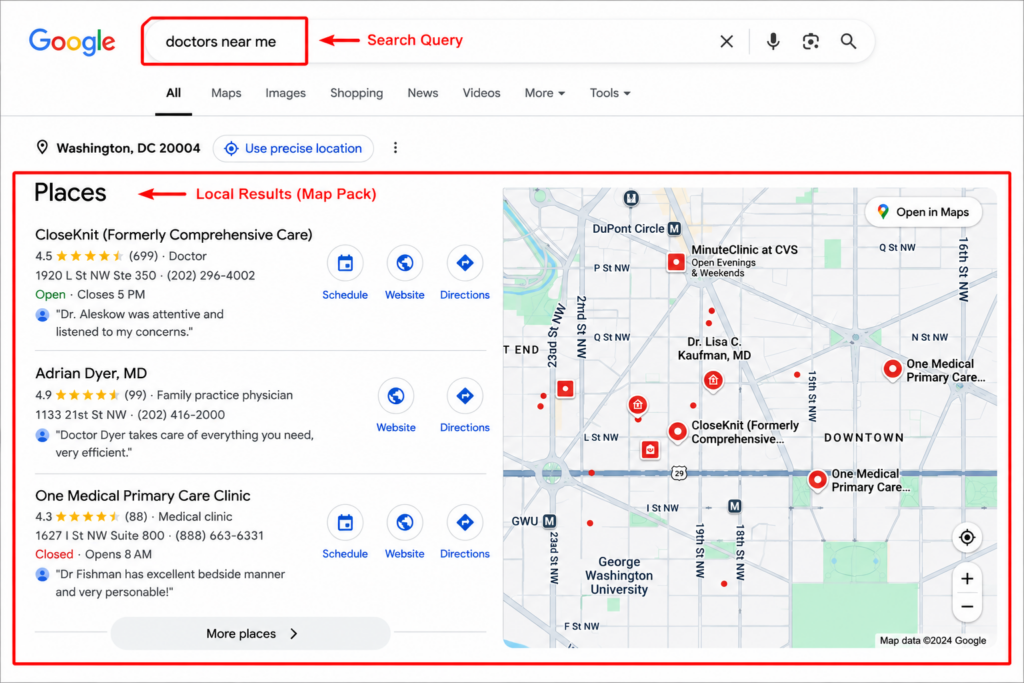
A Google search for “doctors near me” showing how local practices can appear in Google’s local results and Maps.
How Local SEO Is Different From Traditional SEO
Traditional SEO can target broad, informational searches. Local SEO is built around geographic intent specifically.
A search like “what is physical therapy” is informational; the person wants to understand a concept. A search like “physical therapist near me” carries strong local, ready-to-act intent. Both matter to a practice, but they call for different content and different optimization priorities.
| Traditional SEO | Local SEO |
|---|---|
| Targets broad or informational searches | Targets location-based searches |
| Focuses on organic search visibility | Focuses on local search and Google Maps visibility |
| Can target users across different locations | Primarily targets patients in a specific service area |
| Example: “what is physical therapy” | Example: “physical therapist near me” |
| Content often focuses on general education | Content focuses on services, locations, and patient intent |
| Relies heavily on website content and authority | Combines website optimization, Google Business Profile, reviews, citations, and local relevance |
Why Local Search Matters for Medical Practices
Patients research before they book. They’re not just picking the first result; they’re comparing options, checking credibility, and deciding who feels trustworthy enough to call.
Local visibility puts your practice in front of people who are already searching within your service area, which is a meaningfully different starting point than general marketing. That said, ranking well is not the goal by itself. A high ranking that doesn’t lead to a call or a booking hasn’t actually helped your practice.
Patients Search Before They Book
Before calling, most patients look at a combination of signals: reviews, your location, the services you offer, information about the provider, your hours, and your website itself. Missing or inconsistent information at any of these points can quietly cost you a patient who was otherwise ready to reach out.
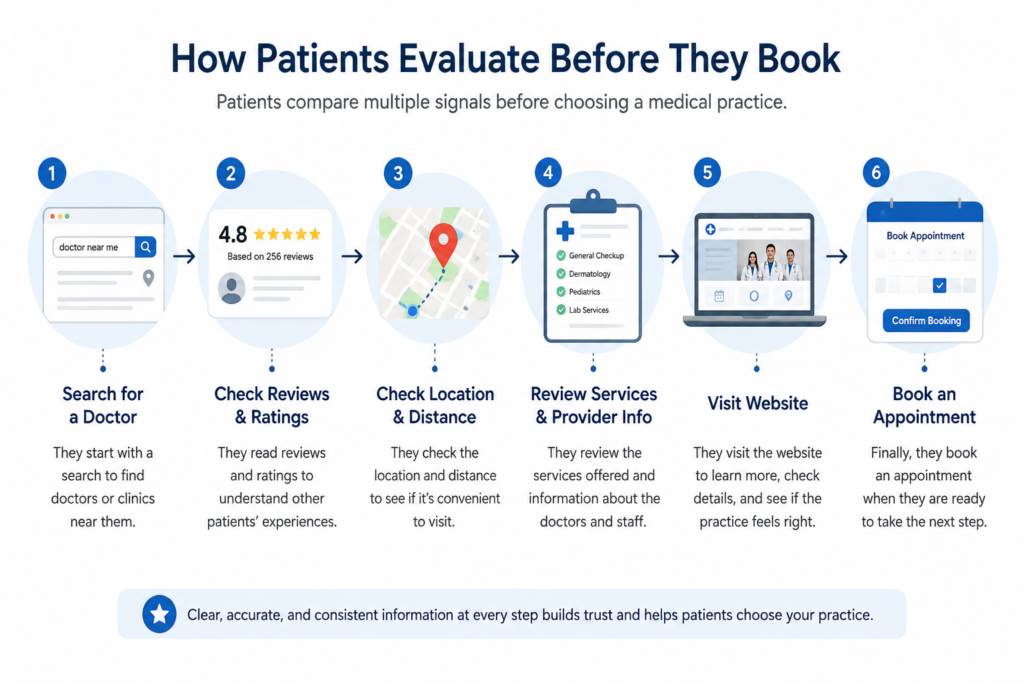
Patients often compare reviews, location, services, provider information, and website details before choosing a medical practice.
Local Searches Often Show Strong Patient Intent
A few common patterns show up again and again: “doctor near me,” “[specialty] near me,” “[treatment] in [city],” and “[specialist] in [location].” The specific wording varies constantly, but the intent behind it, finding a credible provider close by, stays fairly consistent.
What Influences Local Visibility on Google?
Google describes local search results as being shaped by three broad concepts. This isn’t a complete list of every ranking factor, and no one outside Google knows the full picture, but these three give a useful, honest framework to think with.
Relevance
Does your practice match what the patient actually searched for? A dermatology practice with clear, complete information about the conditions and treatments it offers is more likely to match a dermatology-related search than a page that’s vague about what it treats. Clear service pages, accurate Google Business Profile information, and relevant website content can all help reinforce that relevance. A broader SEO audit can also help identify gaps across these areas.
Distance
How close is your practice to the person searching, or to the location they specified? This is largely outside your control, but it’s part of why an accurate address and service area matter so much.
Prominence
How well known and well regarded is your practice online? This can be influenced by reviews, backlinks, mentions across other sites, and the overall strength of your digital presence. Building genuine reviews, earning relevant local mentions, and maintaining a consistent presence across trusted websites can help strengthen that presence over time.
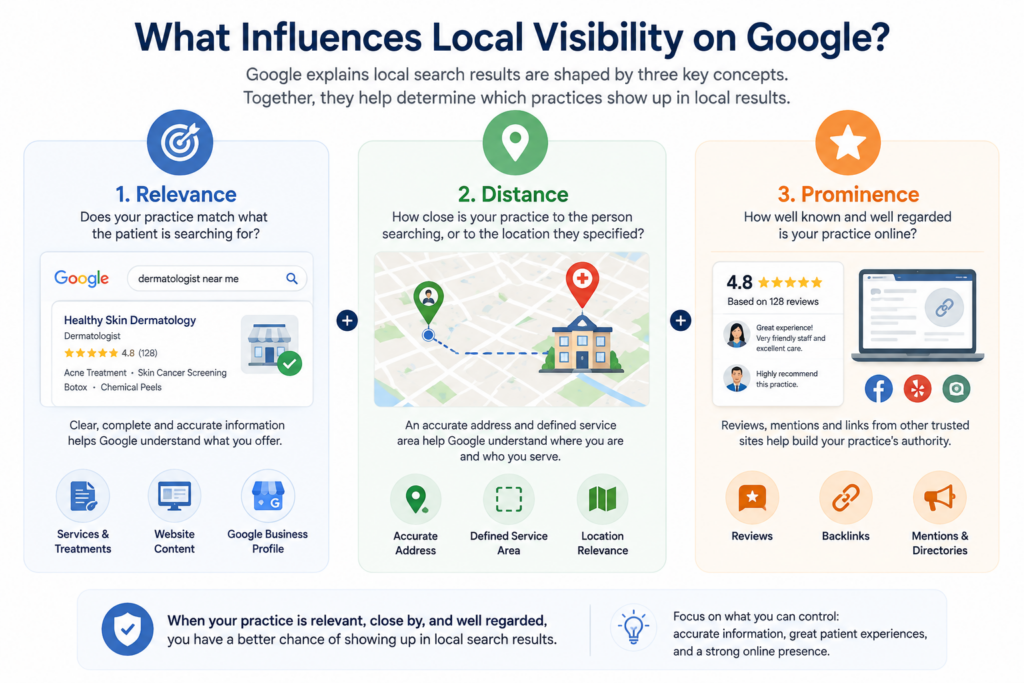
The three key concepts that influence local search visibility are relevance, distance, and prominence.
Optimize Your Google Business Profile for Local Patients
Your Google Business Profile is often the very first thing a patient sees, sometimes before they ever reach your website. A complete, accurate profile includes your correct practice name, primary category, address, phone number, hours, services, photos, your website link, and appointment information.
Choose the Right Primary Category
Your primary category tells Google what kind of practice you are, and it directly affects which searches you’re eligible to appear for. Pick the category that most accurately reflects your practice, rather than stuffing in extra specialties that don’t genuinely apply. Google’s Business Profile category guidelines provide additional guidance on choosing an accurate category.
Add a Clear Business Description
Your business description should clearly explain what your practice does, the patients you serve, and the main services you offer. Keep it natural and useful rather than filling it with keywords.Keep Your Practice Information Accurate
Your name, address, phone number, hours, and website should be correct and current everywhere they appear. Keep regular and holiday hours updated so patients don’t arrive when your practice is closed. An outdated phone number or wrong hours doesn’t just confuse patients, it can also hurt the user experience.
Add Services and Real Practice Photos
List the specific services you offer rather than leaving this section generic, and use real photos of your practice, not stock imagery. Patients want to see what they’re actually walking into.
Add Appointment Information
Make it easy for patients to take the next step by adding an accurate appointment or booking link to your profile. The link should lead directly to the appropriate booking page rather than a generic page that makes patients search for the next step.Add Google Business Profile Posts
Use Google Business Profile posts to share relevant practice updates, services, events, or other information patients may find useful. Keep these updates accurate and focused on helping patients rather than using them simply to repeat keywords.Make Your Medical Practice Website Locally Relevant
A strong Google Business Profile isn’t enough on its own. Your website needs to reinforce that same local relevance, and give patients somewhere useful to land once they click through.
Target Services and Locations Naturally
Your site should clearly reflect the specialties, treatments, conditions, and locations you actually serve, in language a patient would use, not just clinical terminology. Use these terms naturally in relevant page titles, headings, body content, and internal links rather than repeating the same keyword unnaturally.
Build Dedicated Service Pages
Each major service your practice offers deserves its own page, not a single paragraph on a general list. A useful service page includes what the treatment involves, provider information, a few common patient questions, and a clear next step. Where relevant, include the locations you serve and explain how patients can access that service at your practice.
Make Your Contact and Location Information Easy to Find
Your address, phone number, directions, and appointment options should be easy to find from any page on your site, not buried several clicks deep.
Improve Mobile Experience and Page Speed
Most local searches happen on a phone. A slow or clunky mobile experience, hard-to-tap buttons, and confusing navigation lose patients before they ever reach a call or booking action.
Build a Strong Local Reputation With Reviews
Reviews shape both how patients decide and how visible your practice is locally. A steady flow of genuine reviews signals real, ongoing trust, not just a one-time push.
Make It Easy for Patients to Leave Reviews
A simple, direct link or a follow-up message after a visit removes friction and makes leaving a review a two-minute task instead of a chore.
Respond to Reviews Professionally
Responding to both positive and negative reviews, calmly and professionally, shows prospective patients that your practice pays attention and takes feedback seriously.
Avoid Fake or Manipulated Reviews
Buying reviews, incentivizing them dishonestly, or gating which patients get asked violates Google’s policies and puts your entire profile at risk. Genuine reviews, collected consistently, hold up far better over time.
Common Local SEO Mistakes Doctors Should Avoid
- Incomplete Google Business Profile: Missing hours, categories, or services quietly costs visibility every day it goes unfixed.
- Wrong business category: An inaccurate primary category makes you less eligible to appear for the searches that actually matter to your practice.
- Keyword-stuffed business name: Adding extra keywords to your listed business name violates Google’s guidelines and risks a suspended profile.
- Duplicate profiles: Multiple listings for the same practice confuse both patients and search engines about which one is current.
- Fake locations: Listing a location where you don’t have a genuine, staffed presence is a policy violation, not a shortcut.
- Inconsistent business information: Mismatched details across your website, profile, and directories weaken trust signals across the board.
- Thin location pages: Pages that only change a city name rarely rank and rarely help a real visitor.
- Duplicate content: Repeated or copied content across pages makes it harder for search engines to know which page to show.
- Missing service pages: Without dedicated pages, your site has fewer real opportunities to match a specific patient search.
- Poor mobile experience: Most local searches happen on a phone, so a difficult mobile site loses patients immediately.
- Ignoring reviews: An unanswered or unmanaged review profile signals neglect, both to patients and to Google.
- Writing without patient intent: Content built around a keyword rather than the actual question behind it tends to underperform.
How to Measure Local SEO Success for a Medical Practice
Rankings alone don’t tell you whether local SEO is actually working. The real picture comes from connecting visibility to engagement, and engagement to real patient action.
| KPI | What It Tells You |
|---|---|
| Local rankings | Search visibility |
| Google Maps visibility | Local discovery |
| Google Business Profile actions | Patient engagement |
| Organic traffic | Search interest |
| Phone calls | Potential patient interest |
| Direction requests | Local intent |
| Form submissions | Lead generation |
| Appointment requests | Business impact |
| Conversion rate | Traffic quality |
The general pattern to watch is visibility leading to engagement, engagement leading to patient action, and patient action leading to actual business impact. A practice with strong rankings but no calls or form submissions has a real problem somewhere in that chain, usually the website experience, not the ranking itself.
How Long Does Local SEO Take for Doctors?
There’s no universal timeline, and any guide promising a guaranteed number of weeks or months is overselling what’s realistically knowable. Results depend on your local competition, your current website’s strength, the condition of your Google Business Profile, your existing reviews, your overall online authority, and how consistently the work actually gets done.
A practice starting with a reasonably strong website and some existing reviews will typically see movement sooner than one starting from very little. What holds true across almost every practice is that steady, ongoing effort outperforms a single burst of activity followed by nothing. Local SEO also tends to build in stages.
You may see improvements in your Google Business Profile visibility, rankings, website traffic, calls, or other engagement signals at different times rather than all at once.
Final Takeaway
Local SEO for doctors isn’t just about ranking higher. It’s about helping the right nearby patients discover your practice, evaluate whether it’s a good fit, reach out, and ultimately book an appointment.
That takes a Google Business Profile that’s genuinely complete, a website that reinforces the same local relevance, real reviews collected consistently, a credible presence beyond Google, and content that actually answers what patients are asking. None of these work especially well in isolation, they reinforce each other.
Frequently Asked Questions
What Is Local SEO for Doctors?
Local SEO for doctors helps nearby patients find your practice when they search on Google or Google Maps.
How Can Doctors Rank on Google Maps?
Create and optimize your Google Business Profile, keep your practice information accurate, and build genuine patient reviews and local relevance.
Does Every Doctor Need a Google Business Profile?
Yes. A Google Business Profile helps doctors appear in Google Search and Google Maps for relevant local searches.
Do Reviews Help Local SEO?
Yes. Reviews can support local visibility and help patients decide whether to trust and choose your practice.
Should Doctors Create Location Pages?
Yes, when each page provides useful, unique information about that location. Avoid creating thin pages that only change the city name.
How Long Does Local SEO Take?
It depends on competition, your current online presence, website quality, and how consistently you work on local SEO. There is no guaranteed timeline.
Related: Prefer it done for you? Explore Digital Leap’s local SEO company for local businesses across the US.