Healthcare SEO is the process of optimizing a hospital, clinic, or medical practice website so it ranks for the searches real patients run, things like “pediatrician near me,” “signs of a sinus infection,” or “best dermatologist for acne.”
It relies on the same core building blocks as any other SEO strategy, technical work, content, and local visibility, but it carries one extra layer most industries do not deal with. Google classifies health information as YMYL content, short for Your Money or Your Life, and holds it to the strictest quality standard in its Search Quality Rater Guidelines, known as EEAT.
That extra scrutiny exists for a real reason. A patient choosing a doctor is not the same decision as a patient choosing a restaurant, and Google’s own guidelines say as much directly. A 2025 patient survey by rater8, a healthcare reputation management company that polled over a thousand patients across the United States, found that 84% check online reviews before choosing a new provider.
Fewer people are walking in cold. This guide covers what healthcare SEO actually involves, why it works differently than SEO in other industries, and how to stay visible as patients increasingly bring AI tools into that research alongside Google.
What Is Healthcare SEO?
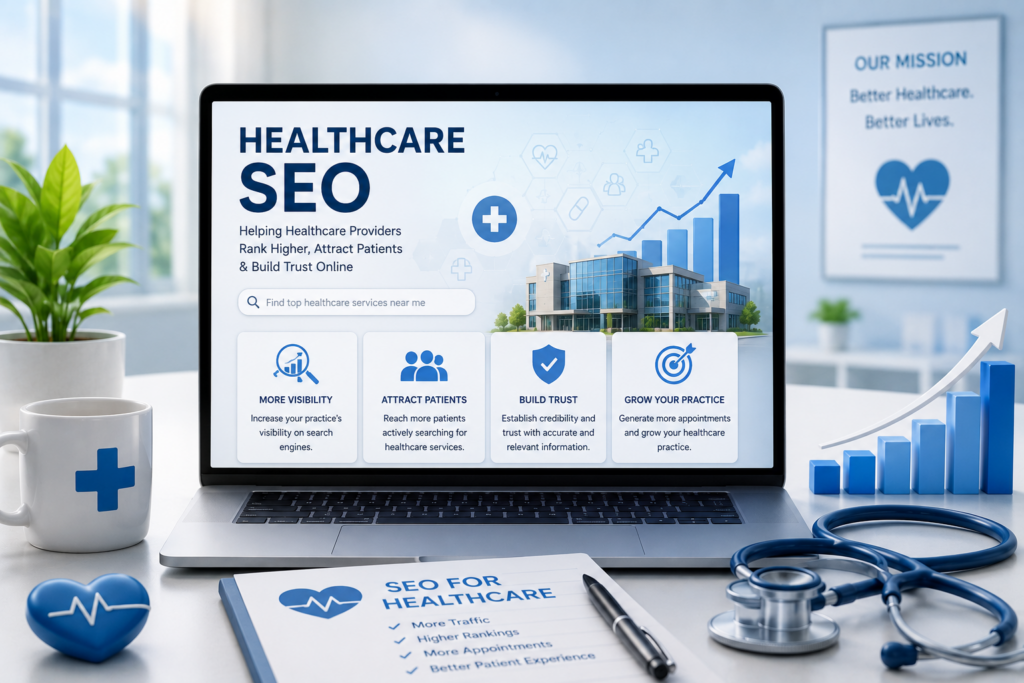
Healthcare SEO is the practice of optimizing a healthcare organization’s website, its content, technical setup, and local listings, so it ranks well for the terms patients search when they’re looking for care, information, or a provider.
Because health information can genuinely affect someone’s wellbeing, Google treats it as YMYL content. YMYL pages are held to a much higher trust bar than a typical blog post or product page, which means accuracy, credibility, and clear authorship carry more weight here than almost anywhere else in SEO.
Healthcare SEO applies to nearly any organization whose patients find them online, including:
- Hospitals and health systems
- Independent and group medical practices
- Specialty clinics, from dermatology to orthopedics to mental health
- Multi-location practices and franchises
- Telehealth providers
Because of that YMYL classification, healthcare SEO isn’t something you can bolt on using generic tactics borrowed from other industries. It needs a strategy built around accuracy, compliance, and trust from the start, not layered on as an afterthought once the site is already live.
Healthcare SEO vs. General SEO: What’s Different
The mechanics of ranking, keywords, backlinks, and technical performance work the same across every industry. What changes in healthcare is the bar Google sets for trust.
- Compliance awareness matters more. Content, testimonials, and tracking tools all need to be handled with an understanding of HIPAA adjacent marketing risk, not just SEO best practice.
- EEAT carries more weight. Author expertise, medical review, and sourcing all factor into rankings more heavily than they would on, say, a product review blog.
- Accuracy is not optional. A factual error on a travel blog is a minor annoyance. A factual error on a page about medication dosage is a genuine safety issue, and Google’s own quality guidelines specifically call out medical misinformation as a top concern.
Healthcare SEO vs. Medical Practice SEO
People often use “healthcare SEO” as an umbrella term that covers everything from a large regional health system down to a single dentist’s office. The strategy scales with the organization.
Large, multi service organizations like hospitals and health systems need enterprise level architecture, with service line pages, location pages, and provider directories that do not compete with or duplicate each other. Smaller practices with one or two locations need a tighter, more locally focused strategy built around a single physical address.
If you run a specialty practice, it is worth looking at a strategy built specifically for your field, such as Dental SEO or Chiropractor SEO, since patient search behavior and competition look different in every specialty.
Why Is SEO Important for Healthcare Providers?
Most patients research a provider online before they ever call. SEO determines whether your practice shows up in that research or gets skipped entirely.
Here is why that matters in practical terms:
- Patients check more than one source. A 2025 patient survey by rater8, based on responses from over 1,000 patients across the US, found that 84% check online reviews before choosing a new provider. Patients rarely stop at a single search.
- Organic visibility compounds. Paid ads do not. An ad stops working the moment you stop paying for it. A well optimized website keeps generating visibility month after month without a new bill attached to every click.
- Healthcare decisions carry more weight than most purchases. Choosing a provider is not like choosing a restaurant. Patients look for credibility signals, clear information, real credentials, useful content, before they ever sit in a waiting room.
The specific role SEO plays also shifts by practice type:
- A med spa usually competes on discovery, getting found by people who did not know a service existed until they searched for it.
- A plastic surgery practice usually competes on trust, since patients research extensively before choosing someone for an elective procedure.
- A therapy practice often competes on both, since patients searching for mental health support want a provider who feels approachable as much as qualified.
In every case, visibility is not the end goal. It is what makes the next step, an actual booked appointment, possible in the first place.
Local SEO Benefits for Healthcare Providers
For most patients, “near me” isn’t a figure of speech, it’s the literal query they type. Local SEO is what determines whether your practice shows up in that map pack at all.
Your Google Business Profile is the single biggest lever here. Accurate hours, services, photos, and patient reviews all feed directly into local visibility, and the map pack is often what a patient sees first, well before they ever click through to your website. If you offer a dedicated local SEO service, this is a natural place to link out to it.
Trust and Credibility Benefits
SEO and patient trust aren’t really separate goals in healthcare, they largely overlap. The same things that help Google trust your content, clear authorship, accurate information, credible sourcing, are the same things that help a nervous patient trust your practice.
That overlap is exactly what EEAT is designed to measure: Experience, Expertise, Authoritativeness, and Trustworthiness. Building it into your content isn’t a box to check, it’s the actual mechanism by which both Google and real patients decide whether to trust what you’ve published.
How Does Healthcare SEO Work?
At a high level, search engines and AI systems are all trying to answer the same underlying question: is this the most relevant, trustworthy source for what someone just searched? They judge that using signals that fall into four broad categories:
- How relevant your content is to the query
- How technically sound your site is
- How authoritative your domain is
- How trustworthy your content actually reads
Healthcare SEO strategy is the deliberate work of strengthening all four of those categories, rather than hoping they improve on their own. The next section breaks each one down. Increasingly, these same signals also decide whether AI systems like Google AI Overviews, ChatGPT, and Perplexity choose to cite your content directly, a topic covered later in this guide.
The Core Pillars of a Healthcare SEO Strategy
| Pillar | What It Covers |
|---|---|
| Local SEO | Google Business Profile optimization, consistent business listings, and location pages |
| On-Page SEO & Content | Service pages, condition-related content, and patient-friendly language |
| Technical SEO | Site speed, mobile experience, HTTPS, crawlability, and indexability |
| Authority & Off-Page SEO | Backlinks from reputable medical directories, healthcare organizations, and professional associations |
| E-E-A-T & Trustworthiness | Author expertise, medical review, credible sourcing, and transparent health information |
Local SEO
Local SEO helps nearby patients find and choose your practice. It covers your Google Business Profile, consistent business details across the web, and a dedicated page for each location. The more locations you have, the more this matters, since each one needs to show up on its own.
On Page SEO and Content
This is your website’s content: service pages, condition pages, and anything that answers a patient’s questions in plain language. Good healthcare content explains things the way a doctor would in an appointment, not the way a textbook would. Our on page SEO services focus on exactly this, turning plain, clear content into pages that also rank well.
Technical SEO
Technical SEO covers the parts patients never see: page speed, mobile experience, and how easily Google can crawl your site. This matters more in healthcare than people think. A slow, clunky website loses patients before they ever reach a booking form. Our technical SEO services fix these issues before they start costing you patients.
Authority and Off Page SEO
Authority comes mainly from backlinks, links from medical directories, associations, and local press. In healthcare, these links do two things at once. They tell search engines your site is trustworthy, and they show patients you’re a credible, established practice. Our link building services focus on earning exactly these kinds of credible, relevant links.
EEAT and Content Trustworthiness
This pillar is about author expertise, medical review, and where your information comes from. Because healthcare content is YMYL, this matters more than any other pillar. A fast, well built site with unreliable content will still struggle to rank.
How Is Healthcare SEO Changing With AI Search?
Patients no longer rely only on a page of blue links. A growing share are getting direct answers from Google AI Overviews, ChatGPT, Perplexity, and Gemini instead, asking things like “what are the symptoms of a sinus infection” or “what should I look for in a good orthodontist” and getting a synthesized answer on the spot.
Some of the same shift shows up in how patients say they’re choosing providers today, and it’s a trend worth tracking closely rather than dismissing as a passing fad. The same fundamentals that help you rank in traditional search still matter here, accurate, well organized, authoritative content is still the foundation.
But structure now plays an outsized role in whether an AI system can actually extract and cite your content. Clear answer sections, logical headings, and structured data all make it easier for a model to pull a fact from your page with confidence.
Common Healthcare SEO Mistakes to Avoid
Most healthcare websites lose visibility to a handful of recurring problems, not one single mistake. Here are the five we see most often, in roughly the order they tend to cost you the most.
Ignoring Local SEO
An incomplete or outdated Google Business Profile quietly costs you map pack visibility and near me bookings. Most practices don’t notice until traffic has already dropped, since local visibility fades gradually rather than all at once.
Duplicate Content Across Location Pages
Templated pages that only swap out a city name read as low value to search engines. If you run more than one location, each page needs to say something genuinely different, not just a different address at the top.
Missing Schema Markup
Without structured data, both search engines and AI systems have to work harder to understand and trust your content. That puts you at a disadvantage before a reader even arrives, since your competitors’ pages may be easier for Google to interpret correctly.
Weak or Missing Author Information
Content published without a clear, credentialed author undercuts EEAT before a reader even finishes the first sentence. A named author with real credentials, and a reviewer where the topic calls for one, signals credibility that an anonymous page simply can’t.
Slow, Mobile Unfriendly Pages
Technical friction loses patients before they ever reach a booking form, no matter how well the page happens to rank. A slow site punishes you twice, once in rankings and once in lost patients who simply give up.
Conclusion
Healthcare SEO isn’t a one time project, it’s a long term investment that compounds over months as trust, authority, and content depth build up together. What’s changed recently isn’t the fundamentals, it’s the finish line. Ranking well on Google is no longer the only goal, being structured clearly enough for AI Overviews, ChatGPT, and similar tools to cite you directly is quickly becoming just as important. A strategy built around real patient trust, from the ground up, is what makes both of those goals possible at once.
If you want a clear picture of where your own site stands, our healthcare SEO services team can walk through your current visibility, on Google and in AI search, and show you exactly where the gaps are.
Frequently Asked Questions
How much does healthcare SEO cost?
Pricing depends on your practice size, number of locations, and how competitive your local market is. There’s no single flat rate, cost scales with scope.
How long does healthcare SEO take to show results?
Most practices see meaningful results within a few months. Local visibility usually improves first, with organic rankings following over time.
Is SEO worth it for a small medical practice?
Yes. Local SEO works especially well for smaller practices, since patients nearby are already searching with real booking intent.
What’s the difference between healthcare SEO and medical practice SEO?
Healthcare SEO is the broader term, covering everything from hospital systems to single practices. Medical practice SEO usually means the smaller, more local version of that same strategy.
How is AI changing healthcare SEO?
Patients now get health answers directly from tools like AI Overviews and ChatGPT, not just search results. Clear, well organized content is more likely to get pulled into those answers.